Contact form

Name

Email *

Message *

Showing posts with label Indian Travelogue. Show all posts

Wednesday, 15 April 2026

Narain Niwas Palace Hotel – A Heritage Hotel at Jaipur, Rajasthan, India


Narain Niwas Palace Hotel

Imagine about India before 1947, a mosaic of glittering princely states ruled by majestic kings, queens, rajas, maharajas, and nawabs. Since 1858, under British paramountcy, these royals bowed to the Crown while preserving their opulent worlds of forts, palaces, and hunting lodges. Then came August 15, 1947: independence dawned, and these states signed Instruments of Accession, folding into the new Indian Union. The era of absolute rule faded; titles dissolved, political power vanished, and in 1971, even privy purses were abolished. Yesterday's powerful rulers awoke to stark realities. Their lavish lifestyles crumbling under mounting bills for sprawling estates painstakingly built by ancestors.


Canon and author

Many palaces fell to time's relentless march. Government seizures turned some into schools, offices, or museums. For the rest, without patronage, their glory dimmed: arches crumbled, marble floors gathered dust, moss cloaked walls, roofs leaked, and termites devoured wood. Heritage teetered on ruin.

Tow away method of a canon

Yet, ingenuity sparked revival. Visionary descendants, backed by investors and supportive government policies, reimagined these treasures as heritage hotels. A new wave of affluent travellers craved not just luxury, but stories soaked in history. Cash registers rang, breathing life into decaying grandeur. Neemrana Fort-Palace in Rajasthan stands as a pinnacle: this 15th-century, 14-tiered marvel was meticulously restored, blending medieval architecture with modern indulgence, drawing global wanderers to its timeless embrace. Several others follow the suit.

These reborn palaces defy decay, preserving cultural lineage while generating income and jobs. They become living legends, boutique retreats, tourist magnets, cultural ambassadors where heritage and hospitality entwine.

A Personal Sojourn at Narain Niwas, the heritage hotel.

Present: The wedding procession arrived

My recent stay at Narain Niwas Palace Hotel in Pink City Jaipur, Rajasthan to attend a wedding transported me straight into this renaissance. The wedding was unique. Groom’s Bengali father (born in Bihar) and Bengali speaking mother (born in Madhya Pradesh) arrived with the groom (born in Andhra Pradesh). The bride’s Marathi father and Rajasthani mother arrived from Shillong (Meghalaya) with their daughter (born in Rajasthan) for a destination wedding at Jaipur, Rajasthan!

A red carpet welcome

A true Indian wedding, under the starlit sky of Rajasthan. A destination wedding which was special in many ways and the experience is to be remembered forever.

Past: Amar Singh's marriage party just before the baraat procession, in front of Sir Pratap's house, Jodhpore (details about him given below).
Courtesy: https://salute.co.in/the-story-of-maj-gen-amar-singh-kanota/

About the venue.

Welcome!

The Indo-Saracenic architecture of Narain Niwas Palace Hotel transports one back to the bygone era of valour of Rathore kings and administration by European noblemen. The vintage furniture placed in the rooms, intricate frescoes, confuses a visitor – whether one is staying in a hotel or within a museum!

A water filter of yesteryear, made in London

Built in 1928 amid thick forests (now a serene urban oasis), this palace of Anglo-Indian architecture was the vision of General Amar Singh Ji, Thakur of Kanota. He was brave commander of Jaipur State Forces, confidant to Maharaja Sawai Man Singh, and one of the first Indians to serve as an officer in World War I. Grandson of Thakur Zorawar Singh (the Kanota lineage founder) and son of Thakur Narain Singh (Jaipur's police chief and Alwar minister), Amar Singh supervised its completion with his brother Thakur Shivnath Singh. 

When electric kettle was not invented to make tea!!

There is say that about Rajputs that reading and riding together do not augur well. That rule does not apply for Amar Singhji. Under the guidance of Guru Bharat Ram Nathji Ratnoo, his scholastic aptitude bloomed. Sir Pratap Singh, the regent of Jodhpur, popularly known as Sarkar, groomed him as an indomitable fierce soldier. Guru Ram Nathji was his inspiration for writing diaries. In 1894, when Ram Nathji travelled to Europe, he wrote daily diaries which inspired his disciple. 

General Amar Singh Ji, Thakur of Kanota
Courtesy: https://salute.co.in/the-story-of-maj-gen-amar-singh-kanota/

General Amar Singhji meticulously penned diaries for long 44 years (from 1898 to 1942). He chronicled his days meticulously in  English in massive 89 volumes, 800 pages each, missing just one entry after a horseback fall. These pages vividly capture princely India's Victorian and Edwardian splendour. He built a collection of 2300 books on various subjects. He created a treasure trove of 18 photo albums. 


Courtesy: https://salute.co.in/the-story-of-maj-gen-amar-singh-kanota/

Captain Amar Singhji’s first call of duty as Army Officer happened in 1900 to China. With due acknowledgement and credit to the source from internet (https://salute.co.in/the-story-of-maj-gen-amar-singh-kanota/), here are two quotes from his China diary. One is about his preparation for the venture in China and the another one is his personal experience there:

August 12, 1900 (Sunday)

“I had my horses saddled in full marching order and saw that everything was complete. I also bought a watch for forty rupees. After breakfast I put my things right and mended all that wanted repairs, by night train eighty horses started for Calcutta among whom Ghatotgutch, my favourite horse also went.”

October 25, 1900 (Wednesday)

“The people of China are as all know, very industrious and clean, their villages are most beautifully built, their houses are also clean and well-built but contain one storey only. I have not seen a single city belonging to the Chinese people that has two storeys…The most extraordinary thing is that they don’t milk their cows. They don’t know what milk is, all their things are cooked by fat.”

These are two examples of his meticulous writings wherein even minor details were captured through his strong observation power.

In 1916, he was deputed to the Persian Gulf to protect the petroleum oil facilities of British Royal business entities. According to his noting in the diary, thrice he was made officiating command of the regiment (between September 28, 1920 and March 15, 1921). In Indian military history, probably he was the first Indian to command a regiment under British Indian Army. Post retirement from the Indian Army in 1923, he joined Jaipur State Forces and successfully raised a cavalry regiment. He further created the Jaipur Lancers and the headquarters for the Indian Army’s 61st Cavalry. In 1936, he retired as Major General of the Jaipur State Forces. 

Dining Hall of the palace where breakfast is served

Amar Singhji’s had desired that a museum should house priceless pieces of history and heritage. The enormous efforts towards preservation of Kanota Collection is credited to Thakur Sahab Mohan Singhji Kanota and his wife Maaji Sahab Kanota. Amar Singhji’s son Thakur Man Singhji and his wife contacted and coordinated with heritage experts from Victoria and Albert Museum in London, the Imperial War Museum in London, the Intach Library at Mehrangarh Jodhpur and Eka Archiving services in Delhi. The result was establishment of General Amar Singh Library and Museum at Kanota.

Interior of the palace

It is located in Kanota Garh, a castle built in 1872. The collection of memorabilia date back to the era of Thakur Zorawar Singh and subsequent generations. It demonstrates not only family treasure but speaks volume about fascinating lifestyle of the Rajput life, frozen in time.

The vast and varied collection astonishingly boasts about rich family heritage and tradition. Visitors are awestruck at the view of books and diaries, photographs and paintings, maps and manuscripts,  armour to firearms and many more of bygone era.

Cut to present.

Post-independence, the Kanota family's fortunes shifted. In 1978, Thakur Mohan Singh Ji and Thakurani Sahib Narendra Kanwar opened four rooms to travellers at Narin Niwas Palace, birthing a heritage hotel amid evolving tourism. Today, third-generation stewards Thakur Man Singh, Thakur Prithvi Singh, Kunwar Pratap Singh, and Kunwar Mormukut Rathore helm 52 lavish rooms - high-ceilinged sanctuaries adorned with grand furniture, intricate frescoes, and Aravali hill views. Indulgences abound: three resto-bars, boutique shops, a spa, swimming pool, and unwavering Rajasthani hospitality.

Imperial Lancer, the open air dining area (Picture courtesy: Bhaskar)

Dining at Imperial Lancers, the heritage restaurant, blends regal décor with gourmet fare, perfect for lunch or dinner. Evenings pulse with ghoomar dances, gair folk rhythms, and puppet shows, as Rajasthan's soul enchants every bite.

Fountain in the front

Just 11 km from Jaipur airport, 5 km from the railway station, and 3 km from the walled city, its 10-acre expanse offers Shikaar Bagh's lush tranquillity. Peacocks strut the front courtyard at dawn, dance by the fountain at dusk, and as soft lights ignite against the starry night, magic unfolds.

Fountain and palace in the evening

Narain Niwas isn't just a hotel; it's a portal where history whispers through chandeliers and lawns, weaving bygone nobility into modern romance, ideal for weddings or wanderlust. Step through its tall portico, and you'll leave not as a guest, but as a king or queen in your own epic tale, forever changed by Rajasthan's enduring allure.

Padharo sa (Welcome in local dialect)

Disclaimer:
The noble objective of this blog, is to share knowledge through images/pictures and related narration. A few of the scans, featured in this blogpost, are mine while others (sourced from internet) are properties of their respective owners. No intention to infringe any type of copyright. 

The information provided in the article is for general informational purposes only. All information is provided in good faith. No commercial, religious or political angle, whatsoever, is involved. This is not a historical document. Apologies in advance, should there be any inadvertent error. Under no circumstances, I shall have any liability for reliance on any information provided in the story.

************


Thursday, 3 November 2022

A love story embedded stepwell - Adalaj


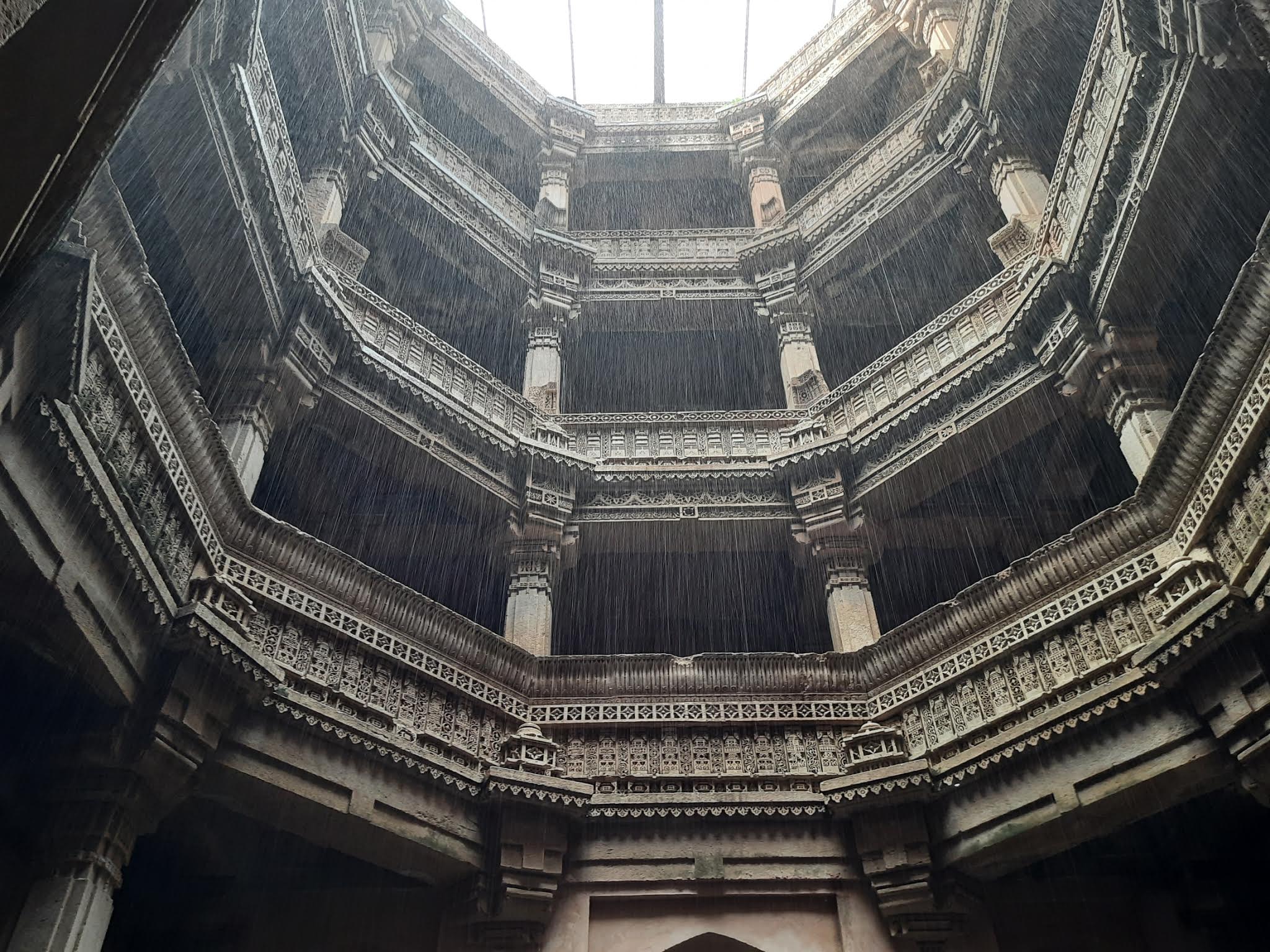
An amazing stepwell at Adalaj

Worldwide people know that mighty Mughal emperor Shah Jahan (1628-1658) had built the famous Taj Mahal in Agra in the memory of his most beloved wife Mumtaz. The mausoleum was built in white Makrana marble from Rajasthan, India in Islamic architecture.


But very few know that a Hindu queen had built an architectural masterpiece in sandstone (as stepwell), in the memory of her late husband king, in a combination of Hindu and Muslim architecture, much before that (1498). 

Today both are standing tall, drawing curious tourists from across the globe. Here goes the story.


The stepwell at surface level

Stepwells primarily acted as secured sources of underground pure water for drinking, bathing and washing. In the construction process, when they were given a dash of religion, these stepwells also emerged as convergence points for the local religious festivals, rituals etc. In local Gujarati language stepwells are called vav (a well accessed through a flight of stairs by going down to the water level). They are also called baoli, baori or bawdi. In the state of Gujarat, there exist about 120 stepwells and several are available in other parts of northern India and Pakistan. While the basic purpose of these stepwells was to provide water for drinking and other household chores, throughout the year, a few have remarkable architectural beauties. Adalaj stepwell is one such marvel which makes the tourists of today awe struck. 


On 29 Dec 2017, India Post issued a set of stamps, depicting surviving stepwells of India. 


The stamp

The famous stepwell of Adalaj was featured in one stamp and one mini-sheet. 


The mini-sheet of stamps

Adalaj is a small village in the present state of Gujarat of India. It is located at about 5 km away from Gandhinagar, the capital of the state. Gandhinagar has a railway station. The distance from Ahmedabad, the nearest airport (Sardar Vallabhbhai Patel airport), is about 18 km. The location is well connected by road. The area is extremely dry and semi-arid zone. The crisis of water was persistent since historical days. The early kingdom suffered due to inadequate rain and perennial water crisis. 


So the rulers of the area, since ages, have always focused on availability of assured sources of water when draught occurred in the region due to delayed or no monsoon at all. They took measures to make water available for the peasants. The common solution was construction of wells. Stepwells were opted by the kings as permanent solution for water scarcity.


The process of well construction turned into a demonstration of royal taste and patronage. Building of stepwells emerged as noble deeds by the kings and queens. Since it was guided and promoted by the rulers, stepwells became show pieces of combination of architecture, aesthetics and engineering skills. It can be inferred that architects had sound knowledge of soil analysis. The massive structures were earthquake resistant, as Gujarat is an earthquake prone landscape.


One step down from ground level

A few interesting details about the Adalaj stepwell was inscribed in Sanskrit on a marble slab which was discovered on the first floor of eastern side entry point. 


A few historical facts

QUOTE

"Samvat 1555 (1498 AD), month of Magha, Mahmud Padshah being king.


"Salutation to Vinayaka (Ganesha) to whose race belonged King Mokala, chief of the country of Dandahi. From him was born Karna, Mahipa, and Virsinh and Naisha were the sons of Mahipa. Virsinh's queen, whose name is Rooda, has constructed this well.


"It is dedicated at this time – when the sun is in the north, the month is Magha, the bright half (Shukla Paksha), the 5th day, the day of the week, Wednesday, the lunar mansion – Uttara, Karana-Bava, the yoga – Siddhi.”


(Source: Wikipedia)

UNQUOTE


Hindus consider this day to be very auspicious and celebrate as Basant Panchami or Shukla Panchami. On this day people worship Goddess Saraswati, who is the goddess of knowledge, literature, music, art etc. It will not be out of point to mention that this author was born on one such Basant Panchami and been blessed by Her. 


Artwork in stone (Picture courtesy: Dr. G C Das)


According to history, the magnificent stepwell at Adalaj was built in 1498 by a queen named Rani Roodabai or Rani Roopba or Rudadevi. Thus, the stepwell at Adalaj is also known as Rudabai stepwell. She built it in the memory of her loving late husband Rana Veer Singh. They were from Vaghela dynasty. By some twists and turns of fate, the construction of this stepwell was commenced by a Hindu king and was completed by a Muslim Badshah (ruler). The result was obvious. The construction has distinct impression of Indo-Islamic architecture. 


In 15th century, the place was known as Dandai Desh and Vaghela dynasty was in reign. King Rana Veer Singh ordered the construction of a large and magnificent stepwell for his countrymen. The engineers, architects, artisans and craftsmen began the work. Meanwhile, the Dandai Desh was attacked by Mohammed Begda, an expansionist Muslim sultan, whose actual name was Abu'l Fath Nasir-ud-Din Mahmud Shah I (25 May 1458 – 23 November 1511). The Begda or Begra or Begarha name possibly originated after he conquered two ('be' in Gujrati language means two) forts (garh) - one each at Junagarh and Pavagarh.


In the fierce battle, unfortunately king Rana Veer Singh was killed. The construction work of the stepwell was suspended. Begda proposed to marry the beautiful widow queen. She had two options at that time. Either to perform Sati (self-immolation by sitting alive on the funeral pyre of expired husband) or to agree to the proposal of the invader sultan. 


After making up her mind and keeping some plan under her sleeves, she conditionally agreed to the marriage proposal of Begda. She conveyed that she was ready to marry him provided he complete the unfinished task of the stepwell. Begda was moved by the charm of the beauty of the queen and was desparate to marry her at the earliest. He agreed to the condition of the queen and mobilised his resources to complete the task. 


With his desire and drive, he completed the building of the magnificent stepwell as quickly as possible. Sandstone was used with mortar as construction materials. The architecture has distinct designs of Hindu and Muslim cultures. While the late Hindu king had added carvings of Hindu Gods Vishnu and other deities, Jain icons, etc., the Muslim ruler characterized the architecture with typical floral motifs and geometrical and symmetrical designs. Kalpavriksha, the tree of life and Ami Kumbhor, the pot with water of life, have been depicted with great care and perfection.


Begda himself was mesmerized by the architectural beauty of the stepwell. On completion, one day he called the six main masons or artisans who had played the lead roles in construction of the stepwell. 

He asked them - ‘Can you build another similar stepwell?’

Those simple poor fellows replied with confidence - ‘Yes sir.’

Begda called his sentries and ordered - ‘Kill them at once and I don’t want another stepwell which can compete with its grandeur.’

People relate six tombs found near the stepwell with this unfortunate incident.


Subsequently, he sent message to the queen to remind her about her promise. The queen responded back that she remembers her words and ready for the royal wedding but before that she would perform a puja (worship) at the newly constructed stepwell. Knowing such rituals are normal for Hindus, Begda, without guessing any foul play and being excited of getting to marry her, agreed to the suggestion.


On an auspicious day, the queen reached the newly constructed stepwell, performed her prayer to the Lord and jumped in the central well. When Begda got the news, all he could do was to fish out her mortal remains from the depth of the well. 


Today the main gates of this historical landmark is open daily from 8 am to 6 pm. 

Welcome

Earlier, entry was free but nowadays an entry fee has been levied. 


The booking counter

There are three entrances to the stepwell at the surface level, one each in the east, west and south, each having the capacity for smooth entry and exit of large number of visitors or water collectors (of the past) at a time. All staircases would lead to the bottom of the well. At present, one entry has been closed to the visitors. 


The geometrical form of the stepwell is amazing, to say the least. At the ground level, the top has octagonal structure. 


Surface level, covered with iron mesh
As one steps down towards the bottom, the temperature drops and humidity is felt. 

Looking downwards from the surface

It has five levels and each level is supported by ornately designed pillars. 


Pillars and supporting beams

Each of the floors are spacious enough to accommodate a reasonable size of gathering. 


Multi-level structure

In peak summer, peasants and travelers would take refuge in the lower strata of the stepwell to escape from the harsh heat of scorching Sun.


All five levels
However, the open top design of the stepwell ensured adequate light, even in the lowermost level, during most part of the day. At the bottom, the stepwell has taken square shape.


From octagonal top to square bottom to circular pond

At the bottom center, there is a pond which is circular in shape. The pond always has the supply of pure and fresh underground water as it is somewhere connected to hidden aquifer. 


One particular aspect needs to be mentioned here. Other than three entrances to the stepwell, there is one exclusive private spiral staircase separated from the public area. 


The 'exclusive' spiral staircase 

From top, it lands directly at the bottom where it has certain partition to prevent direct view from others. It is presumed that it was designed for the women of higher society status or even may be for the queen.


The well as seen from the top

Though rain is rare in this region, during the visit of the author, there was sudden splash of rain for 2-3 minutes. It was a mesmerizing to watch from the bottom of the stepwell. 


A rare rain scene
Tiny droplets of water from the heaven coming through the opening of the well and mingling with static water at the bottom of the well. A scene is to be cherished forever.


Adalaj stepwell is an un-parallel blend of architecture and engineering, juxtaposed with a story of eternal love and tragedy at the end. 


********

Disclaimer:

This is not a historical document. The information provided in the article is for general informational purposes only. All information is provided in good faith. This is only for sharing of knowledge of philately with philatelist fraternity of the world. No commercial or political angle, whatsoever, is involved. No intention to infringe any type of copyright. Under no circumstances I shall have any liability for reliance on any information provided in the story.


--------

Acknowledgement: 

Thankful to Dr. G C Das for introducing to this marvel.


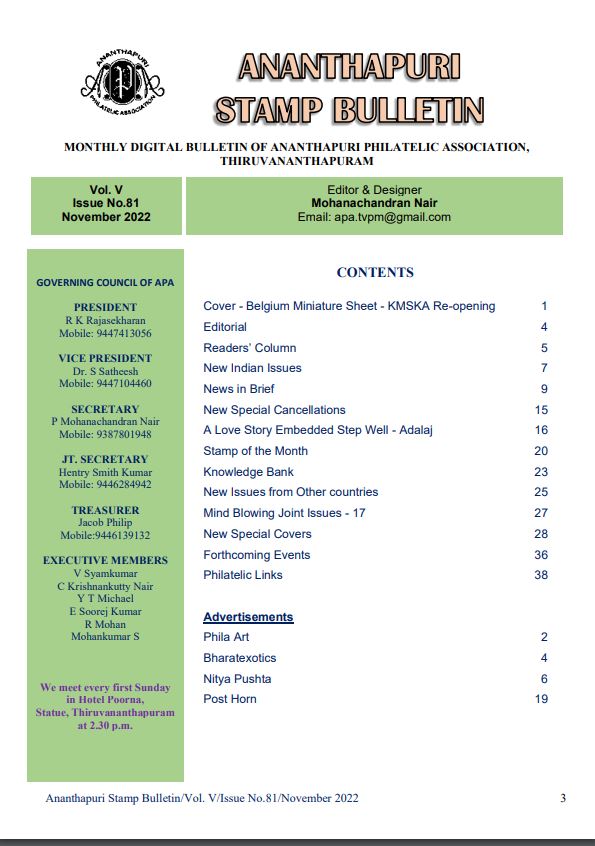
The story, in short form, was published in popular philatelic e-magazine 'Ananthapuri Stamp Bulletin' Nov'2022 issue.


Tuesday, 10 January 2017

Temple of Bells


Temple of Bells
There is an unwritten connection between the bells and religious places. Bells have found distinct places in many religions. Whether it is a Hindu temple or Church of Christians or for that matter some other religion, there will be bells. The decibels, those are created by the bells also vary from one religion to another. Imagine that you are watching a movie. Once you hear the ringing of the bells from on-screen scene in the movie, your audio metric nerves immediately send signals to the brain to distinguish between the sounds of bells from Hindu Temple or Church. Even with the closed eyes you can confidently say that this is a scene at Hindu temple or at Church, only from the frequency and pitch of the sound of bells. 

Devotees at the temple
Dangling bells of different shapes and sizes are integral part of the Hindu temples, irrespective of the idol of God or Goddess sitting inside the temple. The temples are named after the reigning deity in the sanctum sanctorum and bells adore the place of worship.  Interestingly, there is a temple where it has happened other way round. The temple is known as ‘Bell Temple’. Though it is a temple of Lord Shiva, it is called Bell Temple or Tilinga Mandir. In Assamese language, Tilinga stands for bell.

Dangling bells within the premise
The place is Bordubi, a small town located in Upper Assam.


While crossing Bordubi
When one drives from Tinsukia town towards Duliajan along the National Highway no 315A, at a distance of about 20 kilometers, a temple would be found on the left side of the road. In other words, it is short of 7 kilometers from oil town Duliajan on the same direction. Depending upon the traffic conditions it may take nearly one hour to reach Bordubi from Tinsukia. 


Country road
As one draws closer to the temple, series of small shops appear on both sides of the road, selling puja items. Rows after rows of glittering bells dangling outside each shop cannot be missed by anyone passing through that road. 

The temple has a distinct look which is different from other Shiva temples. Instead of typical conical dome at the top, there are one plus three gold colored bells on the top. Interestingly, they are of different sizes and placed in a row. The very first model of the bell is partially fixed on the front porch of the temple. The balance three are full in shape and with increasing sizes i.e. smallest in the front and largest is at the end. 

Bells are everywhere
When this temple was established is not very clear. However, according to local folklore, sometime in Nineteen Sixties, some workers of the local tea garden noticed that one ‘Shiva Linga’ has emerged from underground at the root of a Banyan tree. They started worshiping Shiva and later a small temple was built. Gradually, over time, popularity of the temple increased as the news of its miraculous power spread far and wide. Nowadays , worshipers of Mahakala visit this temple not only from different parts of Assam but from all over India. The faith and trust in the followers of Mahadeva has made this temple a must visit in Upper Assam.

Inside the temple premise, there is a gigantic Banyan tree. At the base of the trunk of the huge tree there are small crevices. 

Sacred Banyan tree
Near that base there is a low table top on which sits a small idol of Hara-Parvati. That’s all about the place of worship and rest of the area is open, calm and quiet. Offerings are kept in front of the base of the sacred Banyan tree. However, an area of concern is that some decay has developed near the root area of the tree. 

Idols of Lord Shiva and Goddess Parvati
The simplicity of worship at this temple is impressive. The process of puja is simple and without much hullabaloo contrast to many other temples. The cacophony of pilgrims and pandits is not found here. Neither blaring bhajans through loudspeakers nor hankering by pandas. The near silence at the place of worship is in resonance with the serene atmosphere of surrounding tea gardens. One can buy ingredients for puja viz. flowers, fruits, sweets, coconuts, incense sticks, scared threads and bells from the temporary shops located outside, on the highway. There is no haggling of price for puja thali etc.

People flock to the temple with different prayers or wishes. As an integral part of the puja, a bell is tied in the branch of the banyan tree. However, over the years the number of people thronging into the temple has gone up and so is the number of bells. It became a Herculean task to accommodate all the bells on the branches of the tree. So to tide over the situation provision was made to hang bells inside the temples on supported iron bars along the boundary wall of the temple. As the numbers bells are ever increasing, arrangement has been done to hang them outside the boundary wall of the temple too, parallel to highway. 

There is no specified size or weight of the bell that can be offered to Maheswara. It can vary from as small as 50 grams to 50 Kilograms or more. Also there is no hard and fast rule about metal or make of the bell. The bell can be made of Brass, Bronze, Copper, Aluminum etc. 

And more bells
Other than offering of bell, some other options do exist. For example, one can also present a Trishul (Trident) to Lord Shambhu. Some people do offer live pigeon to Lord Shankar. It is a common sight that these pigeons hop around and fly in and out of temple premise.

Monday is termed as the day of Lord Umapati and hence every Monday witnesses a mad rush of people and stream of bells. Year after year, bells of different sizes and variety of materials are being presented at the temple. The significant aspect of the temple administration is that till date all the bells have been accumulated and still being stored. As they are treated as gift to Vishveshwara, they are not sold off or disposed of. These stacks of bells, with punctuated tridents, are growing with the passing of every month.

The sight inside the temple premise is simply mind boggling. Thousands of bells are either hanging or stacked in every possible direction. A few of them are brand new and glitter in the rays of early morning Sun like golden bells. Some are tanned due to long exposure to the hot and humid weather of Assam. Some are rusted. On the supports of the bars, bells are hanging, one layer over another and there are several layers. On the heaps, bells are stacked at random. They are literally small mountains of metallic bells. Though dumped, they can easily pass as modern art of bells. Overall it is a marvelous sight. 

Heap of bells of various sizes
Normally a bell is tied with a prayer or wish to Nataraja for fulfillment. But there are incidences when devotees stay at far off places and they are unable to visit the Bell Temple.  They pray to Lord Omkaara to fulfill their prayer with a promise that once the wish is met, they would visit the temple and would tie a bell. So there is a group of devotees who pay a visit to the temple, after their wishes are granted, to tie the bell.

It is believed that the temple has some supernatural mysterious power and the prayers are heard. If the heaps of bells are any indication of rock solid faith of the followers then it can be inferred that ringing of bells at Bell Temple is definitely heard by Nilkanth at Mount Kailash.

Author, during the visit
Fact file
Getting there:

Rail: Tinsukia is well connected by rail through Rajdhani Express and other trains. However, a note of caution is that alighting point is New Tinsukia railway station, as Tinsukia station (old one) does exist and operational.

Air: Nearest airport is Mohanbari (Dibrugarh). There is another airport at Chabua but that is not available for civil aviation. The driving time from Mohanbari airport to Tinsukia is about one hour (45 kms approx.).

Stay: There are a few moderate hotels available. Hotel Highway, Aroma Residency etc., are in a higher bracket accommodation considering Tinsukia is a small town.


One of the hotels

*************************


Bengali version of this travelogue about Bell Temple of Assam was published in the Durga puja souvenir in 2016.
----------------------------------------------------------------------------------------------------------


Narain Niwas Palace Hotel – A Heritage Hotel at Jaipur, Rajasthan, India

  Narain Niwas Palace Hotel Imagine about India before 1947, a mosaic of glittering princely states ruled by majestic kings, queens, rajas, ...