Contact form

Name

Email *

Message *

Thursday, 30 November 2023

The CIA Invert

Source: Internet

- 'Give me back that postage stamp or accept this termination letter for your job!'

Something like this might have happened related to a particular postage stamp. The order was given by none other than C.I.A. (Central Intelligence Agency) of USA, the civilian foreign intelligence service of the federal government of the United States, to a few of its own employees. Subsequently, the stamp became famous as 'CIA invert'. Otherwise, it had nothing to do with the activities of C.I.A. to commemorate. It was a definitive stamp and was purely related to philately.

Normal rush lamp stamp (Source: Internet)

On 02 July, 1979, the United States Postal Service (USPS) issued a postage stamp (Scott 1610) of face value $1, depicting a candle holder with burning candle (rush lamp), under Americana series. “America’s Light Fueled By Truth and Reason” was written on the stamp. The issue of definitive postage stamps of USPS, under Americana series, was in place from 1975 to 1981. The Americana Series superseded the Prominent Americans series, and was in turn superseded by the Great Americans series and the Transportation coils. 

First Day Cover with normal stamp (Source: Internet)

One day, C.I.A. sent one Steve Lambert, its employee to the post office in McLean, Virginia to buy a few postage stamps for official purposes. He went to the post office and purchased a partial sheet having 95 number of $1 stamp and returned to the office. A few days later, another employee of C.I.A. found that there were a few errors in those stamps. There was a mis-match in the direction between the flame of the burning candle and the candle holder or rather they are opposite to each other. Similarly, with respect to the flame, the writings were too inverted. He made a brilliant discovery (in the year 1985).

CIA Invert (Source: Internet)

Subsequently, Steve shared this information confidentially with a close group of his colleague, comprising seven male and two female C.I.A employees (total nine). 
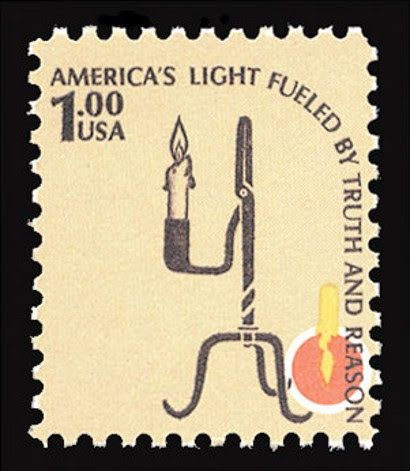
CIA Invert (Source: Internet)

It was a single pane of $1 candle-stand stamps. But out of one hundred stamps of the pane, five were already sold off before by the post office person to some other unknown customers. So, the pane or the sheet was having ninety-five stamps in it - all with identical error. The selvedge part of the pane which carried the plate number was missing. They smelt the financial potential of this finding. 

Both versions together (Source: Internet)

The group of nine C.I.A. employees began making strategy to capitalise the new found treasure. They discussed among themselves and finally came out with the idea that at first they would replace the error pane with normal stamps by purchasing from the post office. Once they replace the errors with valid ones, they would divide the booty among themselves. According to the plan, under the secret operation within C.I.A. office, they pooled the total amount, purchased ninety-five number of normal stamps and substituted them in the office for error stamps. By giving normal candle-stamps to the office, those error stamps came under their possession, which later became famous as ‘CIA Invert’ (Scott 1610c). Each one of them kept one stamp and decided to dispose of the balance (95-9 = 86 stamps) for profit to an auctioneer. They contacted Ike Snyder, the stamp dealer from Annandale, Virginia. Snyder, in turn, suggested them to contact Jacques C. Schiff, Jr., the error stamp dealer of New Jersey. When contacted, Schiff asked them to meet him as quickly as possible. Even he was ready to reimburse the airfare for travel. 

An advertisement (Source: Internet)

On 02 April, 1986, one person on behalf of the group, visited the office of Schiff at Ridgefield, New Jersey. The C.I.A. person wanted $100,000 for the part pane with 85 intact and one damaged stamps. Schiff, being a cunning businessman gave a counter offer of meagre $25,000. A tough bargain followed between two sides. In spite of the best effort by the group side, the dealer didn’t budge from his initial offer of $25,000. Reluctantly, the representative of the group agreed for the offered amount, conditionally. Schiff agreed to the condition that come what may, the identity of the sellers would not be disclosed to anyone. He issued nine  cheques, each for an amount of $2,777.78 for the purchase of the partial pane of 85 intact mint stamps ($2,777.78 X 9 = $25,000). One damaged stamp (86th one) was given to him as complimentary. 

De-classified C.I.A. document (Source: Internet)

Such news could not be kept secret for longer time and somehow it reached the media houses. What subsequently followed was media blitzkrieg through print and audio-visual network (newspapers - The New York Times and CBS news, tv channels etc.). 

The first pane (Courtesy: Linns.com)

Fred Boughner first brought the CIA Invert story to general public through Linn’s Stamp News (issue 11 August, 1986). In the story, it was reported that those stamps were bought by a small business in Fairfax, Virginia. Subsequently, Don Sundman, president of Mystic Stamp Co., filed a Freedom of Information Act request with the Bureau of Engraving and Printing. The printing agency revealed the involvement of C.I.A. The Bureau of Engraving and Printing had launched an investigation. It had concluded that this was a genuine error which had slipped all checkpoints prevailing at that point of time.

The office of C.I.A. was alerted about CIA Invert which was a big sensation by that time. The agency started their own internal ethics investigation and all nine employees involved in the matter were identified. The office contented that those stamps were purchased with government fund and hence they are properties of the state. They are liable for punishment for using government’s property for personal gain – a gross misconduct. Those employees were ordered to return those stamps from their possession or face imprisonment of ten years and a fine of $ 10,000. 

Four employees (including two ladies) returned their CIA Invert to the office and retained their jobs and the one who claimed that his precious stamp has been lost, continued in the service. On 01 November 1990, C.I.A. donated the recovered CIA Inverts (four in number) to Smithsonian National Postal Museum. Balance four employees (including Lambert), who refused to return their ‘jewels’ were terminated from the job by C.I.A. Nearly twenty years later, the former C.I.A. person who had claimed that his stamp was lost, approached Mystic Stamp Company to sell the ‘lost’ stamp. 

At Smithsonian National Postal Museum, one CIA Invert was placed for display which was donated by Don Sundman, the President of Mystic Stamp Company. These $1 stamps of Americana Series were printed in sheets of 400. Therefore, beside this discovered partial pane of 86 stamps, three more panes each of 100 stamps must have been printed. 

A block of four (Source: Internet)

As per the latest information available, in year 2004, one block of four CIA Invert was sold for $60,000 and another block was sold for $71,875 in 2015. It is said that only three such block exists with the collectors.

With plate ID (Source: Internet)

A new block of four CIA Invert, with intaglio plate number 40971 have appeared on the internet. In all probabilities, it was from the second pane. According to plate number, it was printed between 04 November - 05 December 1985.

However, pane number three and four have vanished in thin air without leaving any clue about their whereabouts. Their existence or destruction has been left to the imagination of the philatelists. May be someday in future, some of them may surface from the closet of some unknown collector.


Webliography:

https://www.stampcommunity.org/topic.asp?TOPIC_ID=84105

https://www.linns.com/news/us-stamps-postal-history/cia-invert-revisited-how-did-it-occur

https://www.cia.gov/readingroom/docs/DOC_0001057538.pdf

https://info.mysticstamp.com/learn/cia-inverts/

https://www.linns.com/news/us-stamps-postal-history/stamps-from-second-cia-invert-pane-found

Disclaimer:

The noble objective of this blog, is to promote the hobby of philately through images of stamps, a few pictures and related narration. The scans of a few stamps, featured in this blogpost are mine while others (sourced from internet) are properties of their respective owners. No intention to infringe any type of copyright. 

The information provided in the article is for general informational purposes only. All information is provided in good faith. This is only for sharing of knowledge of philately with philatelist fraternity of the world. No commercial or political angle, whatsoever, is involved. This is not a historical document. Apologies in advance, should there be any inadvertent error. Under no circumstances, I shall have any liability for reliance on any information provided in the story.


*************

This story was published in Ananthapuri Stamp Bulletin (January'2024 issue), the popular philatelic e-magazine.

The cover page

The index


Page 1 of 3

Page 2 of 3


Page 3 of 3
A feedback from one of the readers of Ananthapuri Stamp Bulletin.


Thursday, 9 November 2023

Petroleum Philately of India: SERVO, The Lubricant


Servo - My Stamp

On 28 January 2023, a My Stamp and Special Cover on 50 years of Servo brand of lubricants of Indian Oil Corporation Ltd. was issued by India Post. The lubricant brand called Servo was introduced to Indian  market in the year of 1972 by the Fortune 500 company. The formulation of the product and its variety is credited to the Research and Development (R&D) division of Indian Oil Corporation Ltd. The R&D Centre of Indian Oil Corporation Ltd., is located in Faridabad, near New Delhi. It is a great domestic achievement of R&D effort wherein nearly 5300 formulations and 1600 grades of lubricants are made available in the product mix. In collaboration with Original Equipment Manufacturers (OEMs), it is continuously developing new lubricants for different market segments.

Golden Jubilee of Servo

As fuel oils are required to run an engine or machine, lubricant and greases are integral part for keeping the moving parts in a machine well oiled. When two moving parts of a machine, come in contact with each other, friction happens, generating heat and causing erosion of the parts in contact. Lubricants play a critical role by reducing friction and thereby minimising the wear and tear of machines and equipment. Besides reduction in friction, other utilities of lubricants are reduction of oxidation, prevention of corrosion, transmission of power, controlling the generation of heat, seal against dust particles etc. The ability of a lubricant to reduce the friction is called 'Lubricity'. The lubricity of a lubricant enhances the efficiency of the mechanism. 

Servo - My Stamp

History dates back 1400 BC regarding application of lubricants in the wheels of horse driven chariots. However, those lubes were mostly vegetable oil based or sourced from animal fats. Some of such vegetation lubricants were from olive oil, castor oil, peanut oil etc. After 16th century, whale oil and porpoise (aquatic mammals) oil found wide application. Whale fat was one of the most popular lubricant used over a long period of time, across the globe. Vegetable oil based lubricants have limitations of oxidation stability, high pour point etc. As human civilisation moved from manual output to mechanised industrial revolution, the need for lubricants was felt at the factories of mass production. Industrial growth prompted mankind to look for lubricating oils which were much more efficient. Lubricants of petroleum oil origin found their application in the early 1900s. In today’s world, majority of lubricants are based on petroleum oil. 

Servo - My Stamp and Selvedge

As the application of machinery increased by leaps and bounds, it was experienced that petroleum oil based products were not effective enough for the desired task of lubrication. Researchers burnt midnight candles and additives entered in the field of lubricants. Thus, today's lubricants are brilliant and judicious combination of one or more base oils and selective additives to have particular characteristics and performances. In other words, additives are compounds which are blended in a particular ratio with base oils to enhance the performances of the lubricants.

Servo - Full Sheet of My Stamp

Lubricants or 'lubes' are generic terms describing engine oils, gear oils, greases, hydraulic fluids, transmission oils etc. While motor oil enhances fuel efficiency of automotives, gear oil lubricates parts of gear components. Lubricants have application in all types of industry viz. automobile, cement, textile, steel, petrochemical, mining, marine, etc. Based on its utilities, it is broadly classified as automotive and industrial grade lubricants. Automotive lubricants improve vehicular performance and enhances engine longevity. Industrial lubricants are used in heavy duty application of various industries.

Source: Internet

Major players in international lubricant market are Sinopec Corporation of China, Royal Dutch Shell plc of The Netherland, ExxonMobil Corporation and Chevron Corporation of US, BP Plc of U.K., Total S.A. of France, Petronas of Malaysia etc.

The history of petroleum based lubricant production in India dates back 1960s. 

In the year 1962, an agreement was signed between newly formed (1960) Indian Oil Corporation Ltd., and Mobil Petroleum Co. Ltd., New York for setting up two lubricant blending plants, one each at Kolkata (then Calcutta) and Mumbai (then Bombay). On 25 March 1963, a new joint venture company with 50:50 share between Indian Oil Corporation Ltd., and Mobil Petroleum Co. Ltd., was formed and it was named as Indian Oil Blending Ltd., which set up lube plants.

Source: Internet

Lubricants of the joint venture was initially marketed through Mobil network. On 19 July 1974, the said agreement was terminated. The 4000 equity shares of Indian Oil Blending Ltd., that was held by Mobil, was transferred to Indian Oil. Thus, Indian Oil Blending Ltd., became a fully owned subsidiary of Indian Oil. After the expiry of the agreement, effective July'1974, Indian Oil Corporation Ltd., started directly marketing Servo brand lubricants.  

Source: Internet

In the year 1966, another lubricant company named Lubrizol India Limited was formed with 60% of the subscribed equity held by Government of India and balance 40% shareholding by Lubrizol Corporation U.S.A. It was based on continuous Technology Transfer Agreement for transfer of R&D knowledge, manufacturing and formulation technologies etc. The company was involved in development, manufacture and supply of chemical additives and speciality chemicals, chiefly for petroleum sector. The plant was established in 1969 in Mumbai (then Bombay). In March 2000, it was restructured as joint venture with Indian Oil Corporation Ltd. (50:50). Today it is known as Lubrizol India Private Ltd.

Servo - The Super Brand

Servo had made humble entry in Indian market and it has moved from a 'World-Class Engine Oils' to today’s 'World-Class Lubricants'.  The tagline 'Add Servo Add Life' is self-explanatory. 

SERVO ADDS LIFE

In the year 2016, Servo was awarded 'Superbrand' by Superbrands India Pvt. Ltd., the Indian subsidiary of Superbrands, the world’s largest independent arbiter of branding. Presently, the brand is available in 37 global markets, ranging from neighbouring countries e.g. Bangladesh, Nepal, Sri Lanka to Mauritius, Middle East, Thailand, Vietnam, and various African countries etc. Servo has partnered with the Mohammed Yousuf Naghi group of the Kingdom of Saudi Arabia, the renowned business conglomerates of the country.

Source: Internet

In the domestic lubricant segment, major competitors of Servo of Indian Oil Corporation Ltd., are lubricants from the Bharat Petroleum Corporation Ltd. (MAK, Glide), Hindustan Petroleum Corporation Ltd. (Turbo), Gulf Oil International Ltd. (Gulf), and BP p.l.c (Castrol). 

Lubricant from Bharat Petroleum

These five majors occupy about 67% of Indian lubricant market. Besides, there are strong presence of Valvoline, Elf, Total, etc., in the marketplace.

Source: Internet

In 2022, the global lubricant market was worth USD 117.31 billion. During 2022-2029, it is expected to grow at a CAGR 2.3%. The lubricant market of India is the world’s third largest (behind of US and China). While the lubricant market of US is stagnant, the growth noticed in China market is slow.  On the contrary, Indian lubricant market is the fastest growing one. In 2020, the Indian lubricant market was valued at USD 1.4 billion. From 2021 to 2027, it is expected to grow at a CAGR 3.8%. The demand of automotive lubricant is directly related to the sales of automobiles, expansion of road infrastructure, and vehicular movement on road (commercial, passenger and two-wheelers). Under present conditions, all these weathervanes are favourable for Indian lubricant market.

In the quest of sustainability, global automobile industry is firing all cylinders to move from traditional vehicles to electric vehicles (EVs). A demand of new kind of lubricants are expected to emerge in this domain. Side by side, the need of the hour is the collection, disposal and/or re-refining of used lubricants. The used lubricant market in India is a fragmented and in unorganised domain. In order to protect the environment and leaving a better and healthy earth for future generations, all lubricant manufacturers and marketers should create a robust system of collection and proper disposal/processing of used lubricants. The circular economy will benefit all the stakeholders of today and tomorrow. 


Bibliography:

https://www.futuremarketinsights.com/reports/india-industrial-lubricants-market

https://link.springer.com/content/pdf/10.1557/S0883769400055895.pdf

https://www.jetir.org/papers/JETIRZ006093.pdf

https://www.fortunebusinessinsights.com/industry-reports/lubricants-market-101771

https://www.moneycontrol.com/company-facts/indianoilcorporation/history/IOC


Disclaimer:

The noble objective of this blog, is to promote the hobby of philately through images of stamps, a few pictures and related narration. The scans of My Stamp, featured in this blogpost are mine while others (sourced from internet) are properties of their respective owners. No intention to infringe any type of copyright. 

The information provided in the article is for general informational purposes only. All information is provided in good faith. This is only for sharing of knowledge of philately with philatelist fraternity of the world. No commercial or political angle, whatsoever, is involved. This is not a historical document. Apologies in advance, should there be any inadvertent mistake or error. Under no circumstances, I shall have any liability for reliance on any information provided in the story.

*************

This story was published in Ananthapuri Stamp Bulletin (December'2023 issue), the popular philatelic e-magazine.

Cover page

Index


Page 1 of 3


Page 2 of 3

Page 3 of 3


Saturday, 2 September 2023

Petroleum Philately of India: Guwahati Refinery


Petroleum: Formed millions of years ago, from organic matters, under the crust of earth, through natural high pressure and extreme temperature.  Archaeological findings indicate the use of raw petroleum in the days of Pharaohs. In twentieth century and till date, it has become a mighty industrial force to be reckoned with. Its application ranges from illumination to cooking to many others. The modern civilisation is catapulted by and also till date is driven by petroleum oil and its derivatives. Complex hydrocarbons are broken down through refining processes to produce petrol (gasoline), diesel (gas oil), naphtha, aviation fuel, and petrochemicals etc. Natural gas is also found along with petroleum deposits which serves both as fuel as well as feed-stock for several industries.

In recent times, petroleum has turned to be the cause of war and it also happened to be the main driving force of machineries of warfare. On one hand, it has provided several advantages to mankind say greater mobility etc., on the other hand it is the root cause of geopolitics and global warming. The worst part is that hydrocarbons being the chief constituents, it is primarily responsible for carbon emission.

Philately: A hobby of collection and study of postage stamps and allied materials.

Petroleum philately: A special branch of thematic or topical philately, which deals exclusively with petroleum related philatelic materials.

Petroleum philatelic materials: These are postage stamps, revenue stamps, souvenir/miniature sheets, mini-sheets, My Stamps, First Day Covers, Special Covers, aerograms, inland letters, postcards, picture postcards, labels/panes etc., and have images / pictures / sketches, postage marks, franking marks, logos, USPs, trademark etc., on petroleum oil, natural gas and petrochemicals. It spans entire value chain of petroleum industry ranging from prospecting, exploration and production, refining, storage and transportation, distribution and marketing, research and development, to the end-use. Under its gambit, there are personalities, ranging from scientists to industrialists to oil barons, related to the said industry, business and regulatory entities, and a much more. Related occupational hazards and safety issues are also included. Though last but not the least, oil conservation and concern for environment are featured too.

My Stamp - Guwahati refinery

My Stamp: It is a personalised postage stamp issued by India Post. A sort of se-tenant type of pair where one part is the postage stamp and the selvage part may have a company's logo, picture etc. The face value of a stamp is INR 5. The price is INR 300 per mini sheet. One mini-sheet contains 12 stamps and they can be used by post. Any individual can have her/his My Stamp with photograph from India Post for INR 300. This was introduced during World Philatelic Exhibition (INDIPEX 2011) held in New Delhi during 12-18 February 2011. It has become popular for Indian corporate and business entities. For bulk order, the minimum number of My Stamp Sheets to be ordered is 5,000. Thus, the minimum cost for one corporate My Stamp is INR 1,500,000. However, it has caught the fancy of corporate houses as it is a great publicity material. So far, with the issue of about 225 My Stamps for various organisations, India Post has generated revenue worth nearly INR 340 million.

Full sheet of My Stamp

My Stamp of Guwahati refinery of Indian Oil Corporation Limited was issued on 03 August 2023, on the occasion of Diamond Jubilee (60th glorious years) of successful operation of the refinery.

---------------------------------------------------------------------------------

The very first petroleum themed commemorative postage stamp on Indian petroleum industry was issued on 01 January 1962 on ‘Gauhati’ (changed later as Guwahati) refinery.

The first petroleum stamp of India

This particular stamp has several ‘firsts’ in its credit:

1.First petroleum stamp of India

2.Based on first public sector petroleum refinery in post-independence period

3.Released on first January of the year 1962

4.The refinery was dedicated to the citizens of India by Jawaharlal Nehru, the first Prime Minister of independent India on first day of the first month of 1962

Doesn’t it sound incredible!

It may not be out of point to mention that first petroleum product pipeline in India was laid from Guwahati refinery of the state of Assam to Siliguri of the state of West Bengal.

During pre- and post-independence era, petroleum oil business in India was under control of foreign oil companies viz. Standard Oil Company, Esso, Caltex, Burmah Oil Company etc. Since oil was of strategic business, Government of India incorporated Indian Refineries Limited on 22 Aug 1958. With an authorized capital of INR 30 crores, it was assignied the task of setting up of two oil refineries, one each at Guwahati, Assam and at Barauni, Bihar and also oil pipelines. Firoz Gandhi was appointed first Chairman (1958–1960) of Indian Refineries Limited .

Subsequently, another purely national oil enterprise called Indian Oil Company Limited was incorporated under Companies Act 1956 on 30 June 1959, in order to look after the oil marketing activities. Indian Oil Company Limited was entrusted with responsibilities to market petroleum products that would be produced by two refineries, under construction by Indian Refineries Limited, one each at Guwahati and Barauni. S Nijalingappa was the first Chairman (1959–1962) and B Arora was the first Managing Director of Indian Oil Company Limited.

In order to integrate the supply chain and bring synergy, in Sept 1964, Indian Refineries Limited was dissolved and merged with Indian Oil Company Limited. The new entity was named as Indian Oil Corporation Limited - a 100% Indian company was born. P. A. Gopalakrishnan was appointed as the first chairman (1964–1966) of Indian Oil corporation Ltd. .

Indian Oil corporation Ltd., established the refinery at a place called Noonmati in Guwahati, on the bank of mighty river Brahmaputra. It is spread over an area of 147 acres of land. The refinery was constructed with Romanian collaboration. The refinery processes petroleum crude oil, exclusively of Assam origin, produced by companies like Oil India Ltd., and Oil and Natural Gas Corporation Ltd. The initial capacity of the refinery was 0.75 million metric tonnes per annum (MMTPA). The refining capacity was enhanced to 1.0 MMTPA in 1986. The capacity is expected to be expanded further to 1.2 MMTPA during the current year 2023. Presently it produces LPG, naphtha, petrol (gasoline), kerosene. aviation fuel, gas oil (diesel), and coke (raw and calcined).

However, the production of refined products by the refinery was in excess of local demand. Later on, Indian Oil Corporation Ltd., laid Guwahati - Siliguri pipeline of 435 km of length and capacity of 1.4 million metric tonnes per annum for movement of refined products from refinery to the demand centres, outside the state. 

On 01 January 1962, the refinery was dedicated to the nation by Jawaharlal Nehru. A commemorative stamp was issued on the occasion.

The first petroleum theme stamp of India

The interesting part in the design of the commemorative stamp was depicting a one-horn Indian Rhinoceros (Rhinoceros Unicornis), along with refinery complex. Rhino is the state animal of the state of assam which reflects its rich natural treasures. The creature is a threatened species. It has been listed as vulnerable on IUCN Red List. 

One-horn Indian Rhino

During his royal visit in December 1911, George V went for a hunting trip to Nepal. In the said hunting party, His Highness was accompanied by Maharaja of Nepal. A total 18 number of defenceless rhinos were killed by the elephant mounted hunting team. In the old photograph, both the dignitaries could be seen seated in their howdahs, on elephant back.

Source: Internet

Once upon a time, Indian rhinos were found in abundance in Indo-Gangetic Plain. However, due to overhunting, poaching, loss of grassland, habitat etc., the number of this otherwise gentle herbivore creature, has dwindled. 

In the bygone era of Indian Maharajas and Nawabs, the organised fight among animals was a way of entertainment for riches and nobles. The fights between two elephants or a pair of rhinos etc., were hosted with much fanfare. While the owner of the winning side would receive prize money, the defeated and injured animal would left to die. A fighting of rhinos, hosted by Maharaja of Baroda, during the visit of H.R.H Albert Edward, Prince of Wales to India (November 1875 - January 1876).

Horns of dilemma (Source: Internet)

During 2000-2006, more than 150 rhinos have been killed by the poachers in Assam. In Assam, rhinos are found in Kaziranga and Manas National Park, and a few other places. About 85% of Indian rhinos of the world are located in Assam. Moreover, 70% of the rhino population has been concentrated in Kaziranga National Park which itself is a big risk for the animal. However, the process of conservation and creation of awareness among local dwellers are yielding positive results.

A Special Cover was issued on 50th year

Availability of crude petroleum oil in the state of Assam was found in 1825 by the British authorities. 

A Special Cover issued on 60th year - with My Stamp

The discovery of an oilfield in Naharkatiya, Assam in 1953, prompted the government to set up a refinery for proper processing of the crude oil. 

A Special Cover issued on 60th year - with stamp on Indian Oil

Reverse of the special cover

A tug of war began between the central government and state government of Assam. Central government wanted to set up a refinery outside the state boundary while people of Assam wanted it within the state. It took the shape of matter of prestige and honor of the people of Assam, resulting in statewide agitation. 

The story unfolded like this.

For refining of newly found Assam crude, central government proposed Barauni, Bihar as suitable location for setting up a new refinery. Assam Oil Company preferred Calcutta (now Kolkata) of the state of West Bengal as the location of refinery. There were justifications for both locations. Barauni scored brownie points because after processing, finished products could be used to meet the demand of petroleum products of eastern and part of northern India. The port facilities of Calcutta port were a gateway for coastal evacuation of refined products. That was its plus point. On the other hand, a strong demand for local site was raised by local population as well as politicians. 

As the matter started heating up, in the year 1956, the All-Assam Oil Refinery Action Committee (AAORAC) was constituted by the local people to press for the demand of local refinery. It spearheaded the agitation demanding that the refinery to process Assam crude must be set up in Assam. It was a long-drawn people's movement which spanned from 1955 to 1957.  Schools, colleges, shops, government offices etc., were frequently shut and picketing by the students was a common sight. So was the law-and-order situation with frequent street fight between agitators and law enforcing authorities.  It was a very much heard slogan chanted by the student activists:

"Ami tez dim kintu tel nidiu." (We shall give blood but not oil.)

At one point of time, Jawaharlal Nehru was forced to comment:

“The question of refinery in Assam could not be resolved through violence; it should be decided only on the basis of feasibility”.

To find an amicable solution, in September 1956, an eleven-member Expert Committee was formed by the central government. S Basistha, the then Advisor to Ministry of Railways was appointed as head of the committee. There was one member, each from Romania and France in the committee too. Incidentally though were representatives from Assam Oil Company in the committee, no member from government of Assam was taken onboard. Jawaharlal Nehru visited the state on 18 October 1956 and he faced the anger of public. 

The first Prime Minister of India - Jawaharlal Nehru

People lined up the road through which he passed. They shouted slogans and hold placards. Some of the slogans read:

"Tel Sodhanagar Asomot Laage, Asomor Udyogikaran Hoboi Laagibo, and Asomor Daabi Maaniboi Laagibo.

(The oil refinery must be in Assam; Assam must be industrialised and the demand of Assam has to be recognised)."

In June 1957, the central government concluded that Barauni would be the most suitable place for processing of Assam crude. It goes without saying this decision added fuel to the already raging fire. Oil Refinery Action Committee began preparation for mass movement. All Assam general strike was observed in the state on 29 July 1957. Everything in the state came to a grinding halt. Several agitators were arrested but the spirit of the people remained high. The central government appointed Foster Wheeler as a consultant to find out a solution and to end the agitation. Finally, government decided and announced that instead of one refinery, there would be two refineries, one each at Barauni, Bihar and at Noonmati, Assam. Subsequently, the agitation in Assam was withdrawn. 

The Indian government entered into an agreement with government of Romania to establish a refinery in Assam. The government of Romania provided a soft loan of INR 5.6 crores to Indian government, at an interest rate of 2.5%, repayable in phases. The total cost of construction of the refinery was estimated as INR 17.7 crores. Romania provided technical knowledge, did engineering design, imparted training to Indian engineers (several went to Romania for hands-on exposure). Actual construction was done by Indians under the guidance and supervision of Romanian experts. Equipment and machineries of about 18,500 tonnes were shipped through marine route from Romania, landed at Kolkata (then Calcutta) port and moved upwards to Noonmati project site of Guwahati.

The refinery was finally set up in Guwahati, Assam. Another refinery came up in Barauni, Bihar but that is a different story.

The certificate

It will not be out of point to mention that my petroleum philatelic collection 'Assam - The Maternity Block of Indian Petroleum Industry', under invitee category, was exhibited during ASSAMPEX-2022, the 4th State Level Philatelic Exhibition of Assam, held at Guwahati. A certificate and a trophy were awarded.

Webliography:

https://iocl.com/pages/guwahati-refinery

https://webology.org/data-cms/articles/20220324065610pmwebology%2016%20(1)%20-%201%20pdf.pdf

Disclaimer:

The noble objective of this blog, is to promote the hobby of philately through images of stamps, a few pictures and related narration. The scans of My Stamp, featured in this blogpost are mine while others (sourced from internet) are the properties of their respective owners. No intention to infringe any type of copyright. 

The information provided in the article is for general informational purposes only. All information is provided in good faith. This is only for sharing of knowledge of philately with philatelist fraternity of the world. No commercial or political angle, whatsoever, is involved. This is not a historical document. Apologies in advance, should there be any inadvertent mistake or error. Under no circumstances, I shall have any liability for reliance on any information provided in the story.

***********


Saturday, 26 August 2023

Petroleum Philately of India: Panipat Refinery

Panipat Refinery My Stamp of Indian Oil Corporation Ltd.

Petroleum: Formed millions of years ago, from organic matters, under the crust of earth, through natural high pressure and extreme temperature.  Archaeological findings indicate the use of raw petroleum in the days of Pharaohs. In twentieth century and till date, it has become a mighty industrial force to be reckoned with. Its application ranges from illumination to cooking to many others. The modern civilisation is catapulted by and also till date is driven by petroleum oil and its derivatives. Complex hydrocarbons are broken down through refining processes to produce petrol (gasoline), diesel (gas oil), naphtha, aviation fuel, and petrochemicals etc. Natural gas is also found along with petroleum deposits which serves both as fuel as well as feed-stock for several industries.

In recent times, petroleum has turned to be the cause of war and it also happened to be the main driving force of machineries of warfare. On one hand, it has provided several advantages to mankind say greater mobility etc., on the other hand it is the root cause of geopolitics and global warming. The worst part is that hydrocarbons being the chief constituents, it is primarily responsible for carbon emission.

Philately: A hobby of collection and study of postage stamps and allied materials.

Petroleum philately: A special branch of thematic or topical philately, which deals exclusively with petroleum related philatelic materials.

Petroleum philatelic materials: These are postage stamps, revenue stamps, souvenir/miniature sheets, mini-sheets, My Stamps, First Day Covers, Special Covers, aerograms, inland letters, postcards, picture postcards, labels/panes etc., and have images / pictures / sketches, postage marks, franking marks, logos, USPs, trademark etc., on petroleum oil, natural gas and petrochemicals. It spans entire value chain of petroleum industry ranging from prospecting, exploration and production, refining, storage and transportation, distribution and marketing, research and development, to the end-use. Under its gambit, there are personalities, ranging from scientists to industrialists to oil barons, related to the said industry, business and regulatory entities, and a much more. Related occupational hazards and safety issues are also included. Though last but not the least, oil conservation and concern for environment are featured too.

My Stamp: It is a personalised postage stamp issued by India Post. A sort of se-tenant type of pair where one part is the postage stamp and the selvage part may have a company's logo, picture etc. The face value of a stamp is INR 5. The price is INR 300 per mini sheet. One mini-sheet contains 12 stamps and they can be used by post. Any individual can have her/his My Stamp with photograph from India Post for INR 300. This was introduced during World Philatelic Exhibition (INDIPEX 2011) held in New Delhi during 12-18 February 2011. It has become popular for Indian corporate and business entities. For bulk order, the minimum number of My Stamp Sheets to be ordered is 5,000. Thus, the minimum cost for one corporate My Stamp is INR 1,500,000. However, it has caught the fancy of corporate houses as it is a great publicity material. So far, with the issue of about 225 My Stamps for various organisations, India Post has generated revenue worth nearly INR 340 million.

-------------------------------------------------------------------------------------------------------------
The name of Panipat reminds one about the historical background of a location in India where three fierce battles were fought and which had changed the political course of the country.

The first battle of Panipat (Courtesy: Wikipedia & Baburnama)

The First Battle of Panipat was fought on 21 April 1526 between Sultan Ibrahim Lodhi, the Afgan ruler of Delhi sultanate and Babur, the aspiring fighter from Samarkand (present day Uzbekistan). According to Baburnama (the autobiography by Babur):

"By the grace of the Almighty God, this difficult task was made easy to me and that mighty army, in the space of a half a day was laid in dust."

That half day war ended the Lodhi rule in India and laid the foundation stone of Mughal empire by Babur.

The second battle of Panipat (Courtesy: Wikipedia & Akburnama)

The second battle at the plain land of Panipat was unfolded on 05 November 1556. It was between Akbar, the Mughal ruler, under the guidance of Bairam Khan and King Hemu who had a strong base in Bengal. In the battle, Hemu was killed and that ended the saga.

The third battle of Panipat (Courtesy: Wikipedia)

The third battle of Panipat took place on 14 January 1761.  It was the last military engagement at that place. A fierce battle unfolded between Maratha Confederacy and the attacking army of Durrani Empire. The Martha military was under the command of Sadashivrao Bhau. They faced the challenge of combined force of invading Afgans, Rohillas led by Abdali, Najib ad-Dawlah and Shuja-ud-Daula. In the battle, Maratha army was defeated.

Nearly 250 years later, at Panipat (though not exactly at the same battle ground), tall distillation columns and other paraphernalia of a very big refinery complex raised its head. A refinery of Indian Oil Corporation Ltd., of capacity of 6.0 million metric tonnes per annum (MMTPA) made a humble beginning in the month of July 1998.

One of the approach roads

It was the seventh commissioned refinery (out of ten refineries) of Indian Oil Corporation Ltd., located at a place precisely called Baholi, Panipat, in the state of Haryana, northern India. It is located approximately 120 km away from Delhi, the national capital of India. Today, rather than a refining plant, it is an integrated complex consisting of a refinery and petrochemical plants, spread over 4222 acres of land. The petroleum location is one of the biggest integrated refinery and petrochemical center in India and it is the third largest in South East Asia.

The flare of Panipat Refinery is visible in the background

With changing market dynamics, the company realigned its market strategy. It ventured into petrochemical business which was more lucrative than fuel business. Accordingly, PX-PTA units were commissioned in June 2006. The petrochemical complex produces PX (Paraxylene) and PTA (Purified Terephthalic Acid). In the manufacturing process, Paraxylene is an intermediate product. This has wide application in the production of Polyester Staple Fibre (PSF), Polyester Filament Yarn (PFY) etc. Benzene is one of the by-products. 

A visit to Panipat Refinery on 16 September 2023

In the meantime, Indian Oil Corporation Ltd., was facing a problem of disposal of surplus naphtha, produced by two hinterland refineries, located at Mathura and Panipat of nrothern India. After establishing itself in the petrochemical business, four years later in the year 2010, Indian Oil Corporation Ltd., added one naphtha cracker plant and matching downstream petrochemical plants at Panipat refinery. On one hand it absorbed the surplus naphtha, at the same time started producing valuable petrochemical products like Polypropylene (PP), Polyethylene (LLDPE and HDPE), Butadiene, MEG etc. PTA and MEG (Mono Ethyl Glycol) are used for manufacturing of polyester yarn and PET bottles. These petrochemicals have huge market demand and that helped the company to shore up its bottom line. Butadiene is used for manufacturing of artificial rubber.

The centre that works behind the screen

Panipat refinery has configuration to process both domestic as well as imported crude oil. It receives imported crude oil from Vadinar, Gujarat through am underground cross-country Salaya – Mathura pipeline. 

Full sheet of My Stamp

Imported crude oil also arrives by Very Large Crude Carriers (VLCCs) at Mundra port in the state of Gujarat and is discharged through Single Buoy Mooring (SBM). The imported crude intake is through a cross-country underground pipeline, originating from Mundra, Gujarat to the refinery at Panipat. The length of the crude pipeline is 1194 km. 

Receiving autographed My Stamp from Executive Director & Refinery Head, Panipat Refinery & Petrochemical Complex

The refinery also intakes R-LNG, for its captive power plant, through a dedicated pipeline from Dadri, Uttar Pradesh. The length and diameter of the pipeline are 140 km and 30 inches, respectively. Input at Dadri is from Bijapur-Dadri pipeline of GAIL (India) Ltd. Imported LNG is received at Dahej, a port in the state of Gujarat in the west coast of India. The imported R-LNG at Dahej feeds Bijapur through cross-country gas pipeline. 

The refining capacity of the refinery was enhanced from 6.0 MMTPA to 12 MMTPA in June 2006. The capacity was further expanded to 15 MMTPA (300,000 barrels per day or bpd) in December 2010, which is the present capacity of the refinery. In February 2021, the Board of Indian Oil Corporation Ltd., approved the expansion of the capacity of the refinery from 15 MMTPA to 25 MMTPA (500,000 bpd), a 66.66% increase, which is slated to be completed by September 2024. The estimated cost of the ongoing expansion work is about $4.46 billion (329.46 billion INR).

The refinery at Panipat is crucial for northern and north-western states of India for meeting the demand of petroleum products. The refinery meets the demand of petroleum products not only for the state of Haryana where it is located but also that of the adjoining and nearby states viz., Punjab, Jammu and Kashmir, Himachal Pradesh, Chandigarh, Uttaranchal, part of Rajasthan and Union Territory of Delhi. The supply and distribution of petroleum products from the refinery is done through all modes of transportation - road, railways and a complex network of underground cross-country pipelines.

The increased crude requirement of the expanded refinery would be made good through another new crude pipeline between Mundra and Panipat. The new crude oil pipeline will be also of 1194 km length and capacity 17.5 MMPTA (350,000 bpd) and matching additional tanks (60,000 KL X 9 tanks) at Mundra. 

The new project work is a strategy of the company to expand its presence in the domain of petrochemicals business and simultaneous de-risk its conventional fuel segment.

On successful completion of glorious 25 years, on the occasion of silver jubilee of the refinery, a My Stamp on Panipat Refinery and Petrochemical Complex was released by Indian Oil Corporation Ltd., on 12 July 2023. For India Post, in My Stamp series, this was 224th issue.

The story was published in popular philatelic e-magazine 'Ananthapuri Stamp Bulletin' September 2023 issue. Scans of select pages are as under:

Cover Page


Index Page


This story was published in Winter 2024 issue of 'Petro-Philatelist', the Journal of International Petroleum Philately, a periodical of the Petroleum Philatelic Society International, U.K.,


Editor's Column

Cover page


Page 1 of 3


Page 2 of 3


Page 3 of 3


Webliography:

https://iocl.com/pages/panipat-refinery

https://www.nsenergybusiness.com/projects/iocl-panipat-refinery/

https://www.gem.wiki/Vijaipur-Dadri_Gas_Pipeline_(GREP-I)

Disclaimer:

The noble objective of this blog, is to promote the hobby of philately through images of stamps, a few pictures and related narration. The scans of My Stamp, featured in this blogpost are mine while others (sourced from internet) are the properties of their respective owners. No intention to infringe any type of copyright. 

The information provided in the article is for general informational purposes only. All information is provided in good faith. This is only for sharing of knowledge of philately with philatelist fraternity of the world. No commercial or political angle, whatsoever, is involved. This is not a historical document. Apologies in advance, should there be any inadvertent mistake or error. Under no circumstances, I shall have any liability for reliance on any information provided in the story.

***********


Narain Niwas Palace Hotel – A Heritage Hotel at Jaipur, Rajasthan, India

  Narain Niwas Palace Hotel Imagine about India before 1947, a mosaic of glittering princely states ruled by majestic kings, queens, rajas, ...