Contact form

Name

Email *

Message *

Saturday, 4 March 2023

Amritpex’2023: National Philatelic Exhibition - India

Welcome

Name of the event: National Philatelic Exhibition 2023 or Amritpex’2023

Duration: From 11th to 15th February 2023 (5 days)

Venue: Hall number 05, Pragati Maidan, New Delhi, India

Covered area: 100,000 Square feet (approx.)

Number of frames for display of philatelic exhibits = 1400

Number of exhibits = 20,000+

Number of philatelic exhibitors = 500

Number of categories = 13 (competitive) + Invitee class

Number of themes = 5 

Number of visitors = 25,000+

Number of schools wherefrom students visited = 125 (National Capital Region Delhi) & others schools

Organizer: Department of Post, Ministry of Communication, Government of India

Partner Ministry: Ministry of Culture, Government of India

Collaborated by: Philatelic Congress of India

Estimated (unconfirmed) cost = INR 20 crore (USD 0.24 million)

Highest ever for any national philatelic exhibition.

The venue

The above numbers speak for themselves about the grandeurs and the mega scale in which the philatelic exhibition was recently conducted by India Post. The exhibition showcased the cultural heritage, historical significance, natural beauties, diversity, etc., though a single window and all under one extra-large roof.  It is simply impossible to describe the mega event with the limited vocabulary of the author. This was also termed as Maha Kumbh of Philately.

The entry gate

Kumbh Mela is a religious festival cum pilgrimage for the Hindus associated with the purification of souls by bathing in holy rivers during auspicious time. The frequency of the celebration is every 12 years. It is celebrated in mega scale and hence termed as Maha (great) Kumbh. When any event is celebrated in larger-than-life scale it is compared as Maha Kumbh.

Post offices with architectural beauties

India got independence from British rule on 15 August 1947. On 15 August 2023, it will be clocking 75 years of independence. A nationwide celebration, titled 'Azadi Ka Amrit Mahotsav' (Great celebration of Independence) was commenced on 12 March 2021. It was a countdown of 75 weeks to touch the milestone of 75th anniversary of independence of India. There are five themes of this celebration:

1. Freedom struggle

2. Ideas@75

3. Resolve@75

4. Actions@75

5. Achievements@75

Point for selfie

Philatelic objects of above themes were displayed in Amritpex. The section dedicated to the five exclusive themes of Azadi Ki Amrit Mahotsav witnessed massive response from enthusiastic philatelists. There were more than 200 frames, in this segment alone.

The free entry ticket

In the past, to commemorate 50 years of independence of India, Indepex-97 was held in the year 1997 in New Delhi. The last World Philatelic Exhibition, called Indipex 2011 was held during 12-18 February 2011 at Pragati Maidan (Hall no. 8-11), New Delhi. 

The mascot

Amritpex’2023 was inaugurated by Ashwini Vaishnaw, the hon’ble Minister for Communications, Electronics & Information Technology and Railways, Government of India. The national exhibition was a part of Azadi ka Amrit Mahotsav celebrations. Hon’ble Minister released a commemorative postage stamp on Azadi ka Amrit Mahotsav. During the exhibition, on 14 February 2023, five Special Covers were issued, one each on Birsa Munda, Govind Guru, Puppetry, International Year of Millet and Freedom Struggle of India. It will not be out of point to mention that puppet show was organized at the venue for the visitors, and children in particular.

During the event, 12 postage stamps on the theme of 'Geographical Indications: Agricultural Goods' were issued. There was a mini sheet also with such 12 stamps. 'Bridal Costumes of India' was the theme for the release of another set of commemorative stamps. On the theme, 8 Different stamps were released. There were two mini sheets too, each having four stamps of bridal costume. 'Flavors of Delhi' was the theme for a set of picture postcards released during the event.

G20 Pavallion

The exhibition was a perfect blend of philately, cultural diversity and soft diplomacy. There was a pavilion, within the display area, which highlighted the Presidency of India in global G20 forum. With semi-circular display pattern and flags of 20 G20 countries, it was a popular selfie point for youngsters as well as seniors.

G20 is an international grouping of countries, founded in 1999, comprising of 19 countries plus European Union. Besides member countries, there are nine guest countries and a few invited international organizations. Together they represent about 85% of global GDP, over 75% of global trade and about 67% of world population. India has taken over the presidency of this august body from Indonesia. The tenure of this responsibility will be for one year (01 December 2022 to 30 November 2023). After that, on 01 December 2023, the presidency of G20 will be handed over by India to Brazil.

Numerous workshops, seminars, panel discussions with moderators were organized there to make the event informative and memorable. A panel discussion titled 'Postal Services: A tool for global socio-economic development and connect' witnessed participation of policy makers, across the globe. Those who were physically present in the panel discussion were -

• Jean-Paul Forceville, Director European and International Relations, La Poste, France

• Dr. Vinaya Prakash Singh, Secretary General, Asia Pacific Postal Union

• Vineet Pandey, Secretary, Department of Posts

• Muktesh K. Pardeshi, OSD (G20 Operations), Ministry of External Affairs etc.

A few countries which could not attend physically, contributed virtually. Canada Post, Post Fiji, USPS, UPU etc., were represented through digital mode. The scope of cooperation and mutual support in the areas of postal services were discussed. Emerged points would be further strengthened through UPU and G20 routes.

Riding a time machine

Riding time machine reached 1729 when Anchal Post was introduced in the Kingdom of Travancore and Cochin, South India. One cannot missed their 'Shanka' (Conch shell) emblem on the hexagonal pillar letter postbox. Post independence, Anchal Post was merged with Post & Telegraph Department on 01 April 1951.

The show-stopper of the exhibits was the Championship class. A few other classes (alphabetic order) of exhibitors were:

1. Aero-philately

2. Astro-philately

3. Literature

4. Maximaphilly

5. Modern Philately

6. Open philately

7. Postal history

8. Postal stationary

9. Revenues

10. Thematic

11. Traditional philately

There were exhibits exclusively for First Day Covers, Special Covers, single frame exhibits, thematic, etc. Themes of the exhibits were as wide and as wild as they could be. Some of the exhibits which drew attentions from the visitors were:

1) Indian Crash Air Mails 1919 To 1990

2) Study of Service Stamps of Cochin

3) Refugee Relief Taxes

4) Postal stationeries of Portuguese India, British India, Gwalior State, Post-independence India etc.

Besides, there were hundreds of popular as well as unconventional themes. It will not be out of point to mention that Piyush Khaitan won the ‘Champion of Champions’ award for his extraordinary collection of Indian Crash Air Mails.

Specially crafted zone for people with special needs

One out of the box creation was setting up of Sensorial Zone. This section was exclusively designed for visually challenged visitors. With the help olfactory glands and touching sensation they could experience the stamps. There were perfumed stamps of India Post viz. Jasmine, Rose, Coffee etc., where these special visitors could smell those stamps kept on the stands. There was large replica of commemorative stamp of Louis Braille birth centenary (issued by India Post on 04 January 2009). Besides there were braille inscriptions about the stamps so that the visitors could read. 

Torch bearers of future

School children participated in droves. In the exhibition there were Youth class for students (10-15, 16-18, and 19-21 years). Students participated even under School Collection category. For school children there were galore of activities. 

Hopping for hobby

One of them was workshop of stamp designing. It is indeed a challenge to tell a story in a canvas of size 20 mm X 25 mm. Yes, that is the average size of a postage stamp. Therefore, designing a postage stamp requires plenty of creativity and imagination. 

Artist Shankha Samanta

The soft spoken and low-profile illustrious artist Shri Shankha Samanta conducted the stamp design workshop for them. He is the person who has designed maximum number of postage stamps of the theme of Gandhi, issued by India Post. Besides he has designed several commemorative postage stamps of numerous themes for India Post. There was tremendous response from the participant budding stamp designers of the future. The stamp design contest was conducted by National Book Trust.

Stamp designers at work

There were overwhelming responses by the kids and adults alike, for the Letter Writing Competition. A specially designed postcard, with Amritpex print, was made available to the letter writers. After writing the letters, participants dropped the postcards in a letter box, positioned there. For many it was a revival of old sweet memories of letter writing.

Seminar in progress


In this era of internet and email, when sending letters by post is mostly limited to wedding invitations and a few others letters, organizing philatelic exhibition is a daring act. The philatelists gathered in the exhibition hall were mostly senior citizens. But if we go by the crowd at children area, we can conclude that philately is still alive and thriving. It is in safe hands. Seniors are ready to hand over the baton to upcoming generations.


**********


Webliography:

https://amritpex2023.in/

https://amritmahotsav.nic.in/

https://pib.gov.in/PressReleasePage.aspx?PRID=1899562


Disclaimer:

The noble objective of this blog, is to promote the hobby of philately through images of stamps, a few pictures and related narration. Some of the scans and pictures featured in this blogpost are mine while others (sourced from internet) are the properties of their respective owners. No intention to infringe any type of copyright.

The information provided in the article is for general informational purposes only. All information is provided in good faith. This is only for sharing of knowledge of philately with philatelist fraternity of the world. No commercial or political angle, whatsoever, is involved. Under no circumstances, I shall have any liability for reliance on any information provided in the story.

**************


Thursday, 26 January 2023

Saraswati - The Hindu Goddess of Knowledge


Marble statue of Goddess Saraswati (featured in India Post stamp)

Saraswati, the Hindu Goddess of wisdom is known since Vedic era. In the scripts of Rigveda, Saraswati is also a river. Goddess Saraswati is Goddess of knowledge, wisdom, learning, art, music, literature etc. In Eastern India, she is considered as daughter of Goddess Durga and Lord Shiva. Not only Hindus, but she is worshipped by Jains and some sects of Buddhism.

Ancient civilizations had different names for the goddess of knowledge and wisdom. For the Greeks she was Athena. Mighty Romans had Minerva. In the days of Pharaos, for the Egyptians she was Seshat. In Zoroastrianism, Goddess Saraswati, known as Sraosha, who is the guardian of Earth. It is said  that the souls, in the afterlife, are guided by her. 

Goddess Saraswati has different forms and names in different countries in Asia-Pacific region. In Thailand, her name is  as Surasawadee (สุรัสวดี). In China, she is known as Biàncáitiān (辯才天). In Japan, she is Benzaiten (弁才天/弁財天). In Myanmar, she is worshipped as Thurathadi. in Tibet, she is Yang-chen-ma - the melodious lady.

Saraswati in Thailand stamp (Source: Internet)

Pra Surasawadee of Thailand wears dresses of white colour. Her carrier is peacock who accompanies her. Interestingly, peacock is considered to be representative of pride owing to his beauty and associated arrogance. Presence of peacock with Surasawadee symbolises that external beauty is not permanent but the truth is.

In Japan, there are magnificent shrines of Benzaiten, one each at  Enoshima Island in Sagami Bay, Chikubu Island in Lake Biwa, and Itsukushima Island in the Seto Inland Sea. 

Enoshima is about one hour drive from Tokyo, connected by a bridge with mainland. The entire tiny Enoshima Island is dedicated to Benzaiten, the Buddhist goddess of wealth, music and entertainment etc. At the backside of the island there are  Enoshima Iwaya Caves. The location is considered to be holy, as it is said that Benzaiten had descended there on earth from heaven. The caves were unique creation of mother nature through erosion of rocks by sea waves. There is some similarity between the looks of Goddess Saraswati and Goddess Enoshima Benzaiten. While Saraswati holds Veena in her hand, Benzaiten has Biwa. Veena and Viwa are musical instruments of India and Japan, respectively. 

In Myanmar, students pray to Goddess Thurathadi before going for their examinations. In the idol form, she sits gracefully on a golden Hintha (or Hansa in Sanskrit meaning Swan). In Sanskrit, Saraswati is also known as Hansavahini, means that Hansa is her carrier. The idol of Saraswati is featured in pure white dress and seated on a white lotus, a white swan is found near her feet. White colour symbolises purity and truth. She has books and pen in her hands. Mostly the idol has two hands but a variety with four arms also found in Indian subcontinent. 

Painting by Raja Ravi Verma (Source: Internet)

The painting of Goddess by Raja Ravi Verma (one of the greatest Indian art painter) created in 1896 depicts her in four armed avatar. Thurathadi carries Tipitaka books in her right hand. Hence she is called Tipitaka Medaw. The deity blesses scholars, writers, learners and guards Buddhist scriptures. It is no wonder when it is said that Goddess Thurathadi has origin from Goddess Saraswati. The reference of Goddess Saraswati was found in a Burmese inscription, dating back 1084 AD. 

In Indonesia, the celebration is "Hari Raya Saraswati" which means the Great day of Saraswati. In the Bali pawukon calendar, the Saraswati Day is the last holiday. In the island of Dewata Bali, Dewi Saraswati is worshipped by the students and other learners of Hindu community. Devotees make offerings to the Hyang Aji Saraswati i.e. Goddess Saraswati. The Goddess has four hands and arms holding sacred book, gemitri/tasbih (set of beads for counting sacred recitations), musical instrument etc. She is found in white colour dresses with one white swan sitting near her feet.

Goddess Saraswati depicted in India Post stamp

India Post has issued commemorative postage stamp on Hindu Goddess Saraswati, not only once but twice in succession in the same year. In the year 1975, the first World Hindi Conference(10-12 January, 1975) was held in Nagpur, Maharashtra, India. On that occasion, the first stamp on Saraswati was issued on 10 Jan 1975. The stamp featured a marble statue of the Goddess found out during excavation in 1917 at Pallu village, Hanumangarh district, the state of Rajasthan, India. It dates back twelfth century during the reign of Chauhan dynasty. Presently, the idol is housed at the National Museum of New Delhi, India. It is a brilliant example of Hindu/Jain sculpture of that era. The background of the stamp has a portion of Rig Veda in Devnagri script. At the bottom of the script the theme of the conference 'Vasudhaiva Kutumbakam' is partially visible. Vasudhaiva Kutumbakam means that the world is only one family – the basic foundation of Indian society.

After the World Hindi Conference, another world conference of language was held in India. This was the World Telugu Conference. Both of Hindi and Telugu languages are spoken by vast majority of Indians. While Hindi is considered as national language, Telugu is a regional language. The World Telugu Conference was held in Hyderabad, Andhra Pradesh state of India, and on that occasion on 12 Apr 1975 another commemorate postage stamp was released on Goddess Saraswati. Though both the stamps are identical in design, they differ in color. The Hindi Conference was of purple colour, and the Telugu Conference stamp was of green colour. Both the stamps were of same denomination - INR 0.25.

Students, learners and practitioners of art and music worship Goddess Saraswati on the auspicious day of ‘Basant Panchami’ which is celebrated on the fifth day of the month of ‘Maagh’. Basant season is the spring season and devotees, particularly the younger generation, wear yellow coloured dresses. This normally falls in the months of January or February, every year.

PS: The author was born on an auspicious day of Basant Panchami.

Webliography:

https://vedicfeed.com/goddess-saraswati/

https://palludevi.com/stamp-realeasevn/

Disclaimer:

The noble objective of this blog, is to promote the hobby of philately through images of stamps, a few pictures and related narration. Some of the scans and pictures featured in this blogpost are mine while others (sourced from internet) are the properties of their respective owners. No intention to infringe any type of copyright.

The information provided in the article is for general informational purposes only. All information is provided in good faith. This is only for sharing of knowledge of philately with philatelist fraternity of the world. No commercial or political angle, whatsoever, is involved. Under no circumstances, I shall have any liability for reliance on any information provided in the story.


Wednesday, 14 December 2022

Energy Conservation Day


Hungary (Magyar Posta) - 30 Mar 1984

"The world is on a highway to climate hell with our foot on the accelerator." 

- Antonio Guterres, Secretary General, UN on 07 Nov 2022 at COP27 held at Sharm el Sheikh, Egypt.

*********
Primary energy is a form of energy that is found in nature which has not been subjected to any sort of conversion or transformation process. Primary energy sources are broadly classified under two categories – conventional (non-renewable) and renewable sources. Conventional energy sources are dominated by coal, petroleum oil, natural gas etc. Renewable energy sources are like solar, wind, hydroelectricity, etc. Use of conventional energy results into release of large quantities of carbon di oxide in the atmosphere. Under normal circumstances, such pollutant carbon di oxide remains suspended in the surroundings for an indefinite period. 

According to BP Statistical Review of World Energy 2022, following are the release of carbon di oxide in the atmosphere from energy consumption by the top polluting countries of the world in 2021:

China = 10523.0 million tonnes

USA   =   4701.1 million tonnes

India  =   2552.8 million tonnes 

The more we use fossil fuels like coal, petroleum oil and gas etc., to produce electricity or other forms of energy, the more we release of carbon di oxide in the atmosphere. Moreover, we shall have less fuel in the kitty for future. Energy conservation is the process of reduction of consumption of energy by various methods. 

In order to highlight the need, and importance of energy conservation, and to create awareness on the subject, several countries have issued postage stamps on the topic.

Some of the simple ways for energy conservation are:

1. Switching off the light while leaving the room

LED & energy efficient devices: South Korea 01 Aug 2008

2. Replacing CFL bulbs with LED bulbs

De-plug & Earth Hour: Australia

3. Unplugging the electrical devices when not in use

De-plugging: South Korea 01 Aug 2008

4. Setting of air-conditioner temperature at 26-28 degree Celsius in tropical countries

AC temperature monitoring: South Korea 01 Aug 2008

5. Walking down the nearby markets etc., rather than driving a car

6. Use of more public transport e.g. metro or tube railway etc.

Use public transport: South Korea 01 Aug 2008

Spain also issued a set of three stamps, one each highlighting public transport, room temperature and de-plugging of electrical devices. 

Spain on Energy Conservation

Symbolic bulbs were used in the stamps of China (15 July 1980), Greece (05 May 1980), and Japan (a set of two stamps on 01 Aug 1981).

China on Energy Conservation

Energy efficient bulbs not only conserve energy but also saves money. 

By energy conservation, we try to preserve the limited resources of energy. The approach helps in reducing the burning of fuels like coal, petroleum oil etc., and thereby saving the available resources, minimising waste, reducing cost and protecting environment. It is one of the solutions to mitigate the issues of pollution, release of Green House Gases (GHGs), global warming, etc. It also ensures a greener planet earth for the future generations.

Thus, it goes without saying that there is an urgent need to conserve energy by the global citizens. 

US Post on Energy Conservation

One 10 cent energy conservation stamp was issued by USA on the occasion of 50th anniversary of World Energy Conference held in Detroit, Michigan (23-27 Sept 1974). The stamp was designed by Robert W. Bode from Chappaqua, New York. Esther Porter was the modeler of the stamp and Howard F. Sharpless was the engraver. The stamps were printed by Offset and Giori.

Another related 13 cent stamp on ‘Energy and Development’ was released by US Post on 20 Oct 1977. Those stamps were printed by Bureau of Engraving and Printing.

Source: Internet
The Nederland issued a stamp on similar theme on 25 Jan 1977. The simple design of the stamp conveys the message of radiation and conservation.

France in 1978, drew attention towards economic parameters of energy conservation.

Spain issued a set of two stamps on ‘Save Energy’ on 24 Jan 1979.

A loud and clear message on ‘Save Fuel’ was conveyed through a pair of unique stamps by South Africa on 02 Apr 1979.

In 1979, Germany had issued a beautiful stamp on energy conservation. 


In the following year, in 1980, Greece issued a pair of stamps on the theme.

Greece 1980

Greece 1980

Morocco issued stamp on the theme in 1980.


In the year 1981, Israel issued a stamp highlighting energy conservation. On the same theme, Algeria released commemorative postage stamp in 1990.


On 17 Aug 2005, Indonesia had released a stamp on similar theme. 

Save Energy from Indonesia

Let us have a look at the status of primary energy consumption of India. 

(Figures in exajoules)

Sr. Fuels                         2020         2021

1 Petroleum oil         9.08         9.14

2 Natural gas         2.18         2.24

3 Hydrocarbon subtotal 11.26 11.38

4 Coal                         17.40 20.09

5 Nuclear                 0.40           0.40

6 Hydroelectricity         1.55           1.51

7 Renewable energy 1.58           1.79

8 TOTAL                 32.19  35.43

(Source: BP Statistical Review of World Energy 2022)

Energy hungry India observes ‘Energy Conservation Day’, every year on 14 December. The tradition began on 14 Dec 1991. The Bureau of Energy Efficiency (BEE), under the Ministry of Power, Government of India was tasked to create awareness among Indian citizen about the importance, various methods, associated benefits of reduction of energy consumption and its conservation practices. On 01 Oct 2001, BEE enacted Energy Conservation Act which became effective from 01 Mar 2002. 

In the area of energy conservation, the government of India had started working long before. In 1977, it had established the Petroleum Conservation Research Association (PCRA) under Ministry of Petroleum and Natural Gas. In the year 1992, in order to give stress on the non-conventional sources of energy, the government of India established a separate exclusive ministry, called Ministry of New and Renewable Energy (MNRE). 

Energy Conservation: India 14 Dec 2004

For a country like India, energy conservation is directly related to the savings of foreign exchange (used for import of petroleum and coal) and reduction of emission (target of net zero is 2070). India Post has issued commemorative stamps on energy conservation on 14 Dec 2004. 

On 12 Dec 2022, Government of India approved Energy Conservation Bill (Amendment of Energy Conservation Act 2001), approved by Rajya Sabha, the Upper House on 12 Dec 2022 and Lok Sabha, the Lower House on 08 Aug 2022) paving the way for more fruitful results in this direction. It empowered federal government to specify a domestic carbon credit scheme. It also makes mandatory for the designated big power consumers to source a part of their energy needs from renewable resources. The Energy Conservation Code for buildings will also be applicable for office and residential buildings with a connected load of 100 kilowatt or above. Automobile manufacturers will have to gear up as the energy consumption standards may be specified for vehicles and ships.

Interestingly, the bill was brought by Ministry of Power and not by Ministry of Environment, Forest and Climate Change. Therefore, it will be the responsibility of BEE, as nodal agency, for implementation and monitoring. 

Today, our earth disparately needs energy conservation measures for its future habitats and we all need to do our bits for a greener tomorrow.

********

Disclaimer:

The noble objective of this blog, is to promote the hobby of philately through images of stamps, a few pictures and related narration. Some of the scans and pictures featured in this blogpost are mine while others (sourced from internet) are the properties of their respective owners. No intention to infringe any type of copyright.

The information provided in the article is for general informational purposes only. All information is provided in good faith. This is only for sharing of knowledge of philately with philatelist fraternity of the world. No commercial or political angle, whatsoever, is involved. Under no circumstances, I shall have any liability for reliance on any information provided in the story.


Thursday, 3 November 2022

A love story embedded stepwell - Adalaj


An amazing stepwell at Adalaj

Worldwide people know that mighty Mughal emperor Shah Jahan (1628-1658) had built the famous Taj Mahal in Agra in the memory of his most beloved wife Mumtaz. The mausoleum was built in white Makrana marble from Rajasthan, India in Islamic architecture.


But very few know that a Hindu queen had built an architectural masterpiece in sandstone (as stepwell), in the memory of her late husband king, in a combination of Hindu and Muslim architecture, much before that (1498). 

Today both are standing tall, drawing curious tourists from across the globe. Here goes the story.


The stepwell at surface level

Stepwells primarily acted as secured sources of underground pure water for drinking, bathing and washing. In the construction process, when they were given a dash of religion, these stepwells also emerged as convergence points for the local religious festivals, rituals etc. In local Gujarati language stepwells are called vav (a well accessed through a flight of stairs by going down to the water level). They are also called baoli, baori or bawdi. In the state of Gujarat, there exist about 120 stepwells and several are available in other parts of northern India and Pakistan. While the basic purpose of these stepwells was to provide water for drinking and other household chores, throughout the year, a few have remarkable architectural beauties. Adalaj stepwell is one such marvel which makes the tourists of today awe struck. 


On 29 Dec 2017, India Post issued a set of stamps, depicting surviving stepwells of India. 


The stamp

The famous stepwell of Adalaj was featured in one stamp and one mini-sheet. 


The mini-sheet of stamps

Adalaj is a small village in the present state of Gujarat of India. It is located at about 5 km away from Gandhinagar, the capital of the state. Gandhinagar has a railway station. The distance from Ahmedabad, the nearest airport (Sardar Vallabhbhai Patel airport), is about 18 km. The location is well connected by road. The area is extremely dry and semi-arid zone. The crisis of water was persistent since historical days. The early kingdom suffered due to inadequate rain and perennial water crisis. 


So the rulers of the area, since ages, have always focused on availability of assured sources of water when draught occurred in the region due to delayed or no monsoon at all. They took measures to make water available for the peasants. The common solution was construction of wells. Stepwells were opted by the kings as permanent solution for water scarcity.


The process of well construction turned into a demonstration of royal taste and patronage. Building of stepwells emerged as noble deeds by the kings and queens. Since it was guided and promoted by the rulers, stepwells became show pieces of combination of architecture, aesthetics and engineering skills. It can be inferred that architects had sound knowledge of soil analysis. The massive structures were earthquake resistant, as Gujarat is an earthquake prone landscape.


One step down from ground level

A few interesting details about the Adalaj stepwell was inscribed in Sanskrit on a marble slab which was discovered on the first floor of eastern side entry point. 


A few historical facts

QUOTE

"Samvat 1555 (1498 AD), month of Magha, Mahmud Padshah being king.


"Salutation to Vinayaka (Ganesha) to whose race belonged King Mokala, chief of the country of Dandahi. From him was born Karna, Mahipa, and Virsinh and Naisha were the sons of Mahipa. Virsinh's queen, whose name is Rooda, has constructed this well.


"It is dedicated at this time – when the sun is in the north, the month is Magha, the bright half (Shukla Paksha), the 5th day, the day of the week, Wednesday, the lunar mansion – Uttara, Karana-Bava, the yoga – Siddhi.”


(Source: Wikipedia)

UNQUOTE


Hindus consider this day to be very auspicious and celebrate as Basant Panchami or Shukla Panchami. On this day people worship Goddess Saraswati, who is the goddess of knowledge, literature, music, art etc. It will not be out of point to mention that this author was born on one such Basant Panchami and been blessed by Her. 


Artwork in stone (Picture courtesy: Dr. G C Das)


According to history, the magnificent stepwell at Adalaj was built in 1498 by a queen named Rani Roodabai or Rani Roopba or Rudadevi. Thus, the stepwell at Adalaj is also known as Rudabai stepwell. She built it in the memory of her loving late husband Rana Veer Singh. They were from Vaghela dynasty. By some twists and turns of fate, the construction of this stepwell was commenced by a Hindu king and was completed by a Muslim Badshah (ruler). The result was obvious. The construction has distinct impression of Indo-Islamic architecture. 


In 15th century, the place was known as Dandai Desh and Vaghela dynasty was in reign. King Rana Veer Singh ordered the construction of a large and magnificent stepwell for his countrymen. The engineers, architects, artisans and craftsmen began the work. Meanwhile, the Dandai Desh was attacked by Mohammed Begda, an expansionist Muslim sultan, whose actual name was Abu'l Fath Nasir-ud-Din Mahmud Shah I (25 May 1458 – 23 November 1511). The Begda or Begra or Begarha name possibly originated after he conquered two ('be' in Gujrati language means two) forts (garh) - one each at Junagarh and Pavagarh.


In the fierce battle, unfortunately king Rana Veer Singh was killed. The construction work of the stepwell was suspended. Begda proposed to marry the beautiful widow queen. She had two options at that time. Either to perform Sati (self-immolation by sitting alive on the funeral pyre of expired husband) or to agree to the proposal of the invader sultan. 


After making up her mind and keeping some plan under her sleeves, she conditionally agreed to the marriage proposal of Begda. She conveyed that she was ready to marry him provided he complete the unfinished task of the stepwell. Begda was moved by the charm of the beauty of the queen and was desparate to marry her at the earliest. He agreed to the condition of the queen and mobilised his resources to complete the task. 


With his desire and drive, he completed the building of the magnificent stepwell as quickly as possible. Sandstone was used with mortar as construction materials. The architecture has distinct designs of Hindu and Muslim cultures. While the late Hindu king had added carvings of Hindu Gods Vishnu and other deities, Jain icons, etc., the Muslim ruler characterized the architecture with typical floral motifs and geometrical and symmetrical designs. Kalpavriksha, the tree of life and Ami Kumbhor, the pot with water of life, have been depicted with great care and perfection.


Begda himself was mesmerized by the architectural beauty of the stepwell. On completion, one day he called the six main masons or artisans who had played the lead roles in construction of the stepwell. 

He asked them - ‘Can you build another similar stepwell?’

Those simple poor fellows replied with confidence - ‘Yes sir.’

Begda called his sentries and ordered - ‘Kill them at once and I don’t want another stepwell which can compete with its grandeur.’

People relate six tombs found near the stepwell with this unfortunate incident.


Subsequently, he sent message to the queen to remind her about her promise. The queen responded back that she remembers her words and ready for the royal wedding but before that she would perform a puja (worship) at the newly constructed stepwell. Knowing such rituals are normal for Hindus, Begda, without guessing any foul play and being excited of getting to marry her, agreed to the suggestion.


On an auspicious day, the queen reached the newly constructed stepwell, performed her prayer to the Lord and jumped in the central well. When Begda got the news, all he could do was to fish out her mortal remains from the depth of the well. 


Today the main gates of this historical landmark is open daily from 8 am to 6 pm. 

Welcome

Earlier, entry was free but nowadays an entry fee has been levied. 


The booking counter

There are three entrances to the stepwell at the surface level, one each in the east, west and south, each having the capacity for smooth entry and exit of large number of visitors or water collectors (of the past) at a time. All staircases would lead to the bottom of the well. At present, one entry has been closed to the visitors. 


The geometrical form of the stepwell is amazing, to say the least. At the ground level, the top has octagonal structure. 


Surface level, covered with iron mesh
As one steps down towards the bottom, the temperature drops and humidity is felt. 

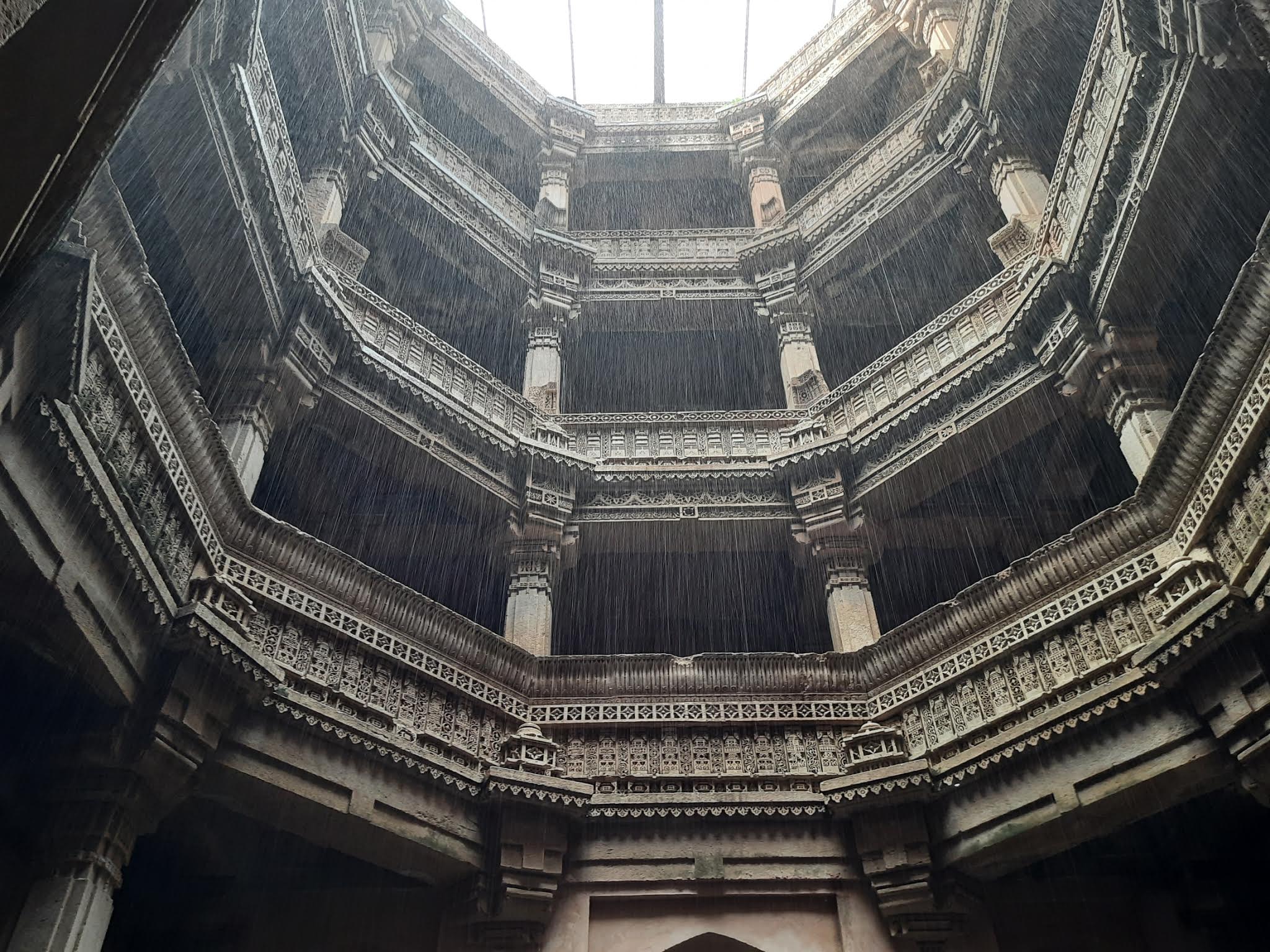
Looking downwards from the surface

It has five levels and each level is supported by ornately designed pillars. 


Pillars and supporting beams

Each of the floors are spacious enough to accommodate a reasonable size of gathering. 


Multi-level structure

In peak summer, peasants and travelers would take refuge in the lower strata of the stepwell to escape from the harsh heat of scorching Sun.


All five levels
However, the open top design of the stepwell ensured adequate light, even in the lowermost level, during most part of the day. At the bottom, the stepwell has taken square shape.


From octagonal top to square bottom to circular pond

At the bottom center, there is a pond which is circular in shape. The pond always has the supply of pure and fresh underground water as it is somewhere connected to hidden aquifer. 


One particular aspect needs to be mentioned here. Other than three entrances to the stepwell, there is one exclusive private spiral staircase separated from the public area. 


The 'exclusive' spiral staircase 

From top, it lands directly at the bottom where it has certain partition to prevent direct view from others. It is presumed that it was designed for the women of higher society status or even may be for the queen.


The well as seen from the top

Though rain is rare in this region, during the visit of the author, there was sudden splash of rain for 2-3 minutes. It was a mesmerizing to watch from the bottom of the stepwell. 


A rare rain scene
Tiny droplets of water from the heaven coming through the opening of the well and mingling with static water at the bottom of the well. A scene is to be cherished forever.


Adalaj stepwell is an un-parallel blend of architecture and engineering, juxtaposed with a story of eternal love and tragedy at the end. 


********

Disclaimer:

This is not a historical document. The information provided in the article is for general informational purposes only. All information is provided in good faith. This is only for sharing of knowledge of philately with philatelist fraternity of the world. No commercial or political angle, whatsoever, is involved. No intention to infringe any type of copyright. Under no circumstances I shall have any liability for reliance on any information provided in the story.


--------

Acknowledgement: 

Thankful to Dr. G C Das for introducing to this marvel.


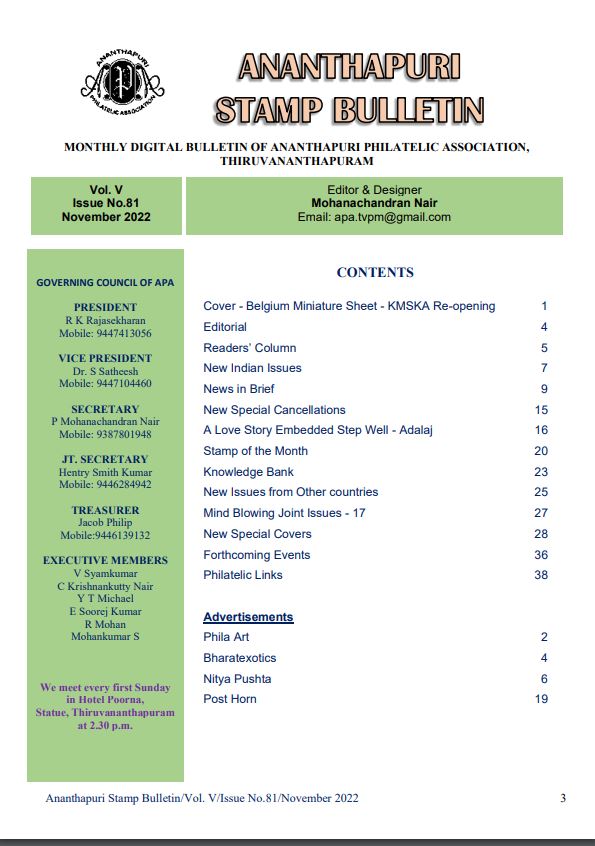
The story, in short form, was published in popular philatelic e-magazine 'Ananthapuri Stamp Bulletin' Nov'2022 issue.


Narain Niwas Palace Hotel – A Heritage Hotel at Jaipur, Rajasthan, India

  Narain Niwas Palace Hotel Imagine about India before 1947, a mosaic of glittering princely states ruled by majestic kings, queens, rajas, ...