Contact form

Name

Email *

Message *

Monday, 18 October 2021

Feeders are true leaders


Feeding at midnight

COVID-19 pandemic has impacted all the seven continents of the world. Each nation is struggling, in their own way, to fight against the deadly disease. Corona prevention protocols have been adopted by human population in order to prevent the spread the infection. Vaccines have been developed by the scientists to control the pandemic. Meanwhile, the virus is undergoing mutation and attacking human with vengeance.

Feeding irrespective of rain or shine

People are wearing masks, some even using double masks while venturing outside. Hand-wash and sanitizer containers are flying off the shelves from the shops, like never before. Social distancing protocol is being considered as an ultimate weapon to rupture the chain of transmission of the lethal virus.

An array of strategies, ranging from Corona curfew to weekend lockdown to regional / state wise / national lockdown are being implemented to win over the latest invisible microscopic enemy of mankind. Non-essential businesses were suspended during lockdown period.

Feeding in deserted parks

People have been barred to cross over the Laxman Rekha of their homes unless it is emergency. Households have built a formidable inventory of ration and consumables to fight a war of different kind. Markets, shops, bar and restaurants, hotels have downed their shutters during such curfews and lockdowns.


Feeding in lonely streets

Blacky, Kalu, Lalu, Lisa, Lusi and for thousands of nameless street babies initially it was pure joy on traffic free streets. But the joy of trouble-free roaming on the road (without automobiles) soon got replaced by the pain of hunger of stomach. These Indies who merely survive on the throwaway scrap from roadside eateries and dhabas, were in dire straights. 'Stay at home' order for humans turned out to be 'starve on streets' for such less fortunate canines of streets. The leftovers from these restaurants and hotels, which they would scavenge for survival, were no longer available. They lost their main source of survival.


A helping hand for the hungry

Forget about food to eat, not even a drop of drinking water was available for many of them. The situation started in early Mar 2020 when the whole country went for first phase of lockdown. The lockdown was subsequently extended and lifted later. A year later, with the emergence of double muted version of the virus, the corona curfews and state wise lockdowns are still creating havoc for these street babies. They include stray dogs, moholla cats, ownerless cows and ox, donkeys, monkeys, horses, asses, birds etc, the list is endless.

Reports of starvation death for such voiceless creatures are pouring in from all over the country. Helpless hungry dogs eating their own poops, soils etc as their last resort to survive in this cruel world. Even then, many of them could not escape from the jaws of certain starvation and death. Finding of carcasses of the street dogs from different corners of the country became common with the progress of days.

Perturbed by the pathetic situation, some people decided to do something for them. Certainly, on this earth, there is also no dearth of good Samaritans. Several kind heart souls came forward to reduce the sufferings of these voiceless creatures. They continued to venture on the roads in the middle of pandemic induced lockdowns with dog-feed. Incidentally, animal lovers and activists who ventured outside for feeding the dogs of the locality, during lockdown period, faced a lot of objections from different corners.

In urban areas, in some housing societies, there was sharp division among residents - dog-feeder and animal haters. In many places it resulted into disturbing  acrimonious situations. It ranged from abusing,  physical assault to police cases. Each tried to interpret the restriction as per own convenience.

On 24 Mar, 2020 Hon’ble Maneka Gandhi (Member of Indian Parliament, animal rights activist, and environmentalist) tweeted "Any dog feeder can go to their district office in delhi and get a feeder pass. Please start today as only 50 passes are being given per district."


Inspiration for many

Animal Welfare Board of India was also kind enough to bring the act of feeding street dogs as an essential service.

This tweet from Maneka Gandhi emboldened the volunteers and gave some authority. Though the tweet was pertaining to capital Delhi, it had ripple effect all over the country. Dog feeders started contacting respective district head quarters for such kind of authorization to feed the hungry street dogs.


A sample Pass

Actions were seen on the ground. At several places, concerned authorities started issuing ‘Hotspot Feeding Passes’. Though it was grossly inadequate in terms of number of requests received from the volunteers, it was a game changers. Till such time, volunteers who were feeding dogs on the road would face objections from law and order implementing authorities.  With this special hotspot passes they continued the voluntary task of feeding those unfortunate streeties.

People from all strata of society came forward for this noble cause. People with such soft-heart ranged from Chief Minister of a state to renowned celebrities to common men/women, spread across the nook and cranny of the country.

A 14-day Coronavirus lockdown in the state of Odisha was imposed effective 05 May, 2021 till 19 May, 2021. On 09 May, 2021, Naveen Patnaik, Hon’ble Chief Minister, Odisha sanctioned funds from Chief Minister’s Relief Fund (CMRF) for feeding stray animals in all urban pockets during the lockdown.  

The official announcement was -

"The lockdown is now underway across the state to control the pandemic. Therefore, stray dogs and cattle are deprived of food... The CM has approved sanction of Rs 60 lakh from his relief fund."

The daily amount earmarked for distribution through Municipal Corporations (Rs. 20,000 X 5), Municipalities (Rs. 5000 X 48) and NAC - Notified Area Council (Rs. 2000 X 61) are for feeding of stray dogs, cattle and birds as well.

However, since the administrative bodies may not have that kind of expertise or manpower to execute the work, it would ultimately rest on the shoulders of foot soldiers. The feeders would take the responsibility of ensuring that the feed reaches the mouths of those hungry creatures.

The size of the problem is gigantic in scale. Street dogs are suffering all over the country. There are several critical issues to feed them. Namely, the non-availability of volunteers in any particular locality zone or locality, lack of transport, fund crunch etc. However, there is a say ‘when there is will, there is a way’. This proverb was proved correct once again in this challenging time.

Dog lovers started networking through Whatsapp group. The existing Whatsapp groups are strengthen further with inclusion of more like minded persons. The demography of the groups is diverse. It ranged from housewives to office goers (working from home), college/University students and it is gender neutral. Every animal lover voluntarily shouldered the responsibility of feeding starving street dogs in their respective locality.

In some areas, where multi-storied residential complexes were sealed due to detected COVID-19 cases, volunteers from nearby areas would come in their own transport and carload of food for the street dogs. One dog feeder group would communicate and coordinate with other groups through whatsapp.

The feeding location would be some sort of battlefield. Every hungry dog would try to have his/her share first. Commotion and dogfight would ensued.  But the volunteers were skilled and experienced enough to handle those situations. With loads of love and strict discipline they would ensure that everyone would get some bite, till the next feed was made available.

The present situation is far from normal. There is urgent need to have a strong network, pan India basis, with adequate cash flow for taking care of the street dogs. The efforts being made by the feeders are appreciated but it is necessary to strengthen it with both financial support and spreading awareness among people. If every family of a locality can spare a few rotis daily, it will be a life savior for many street dogs. We can not expect many families to go for feeding but they can provide the support in various forms. The feeding part will be taken care by the feeders but a network is needed to collect the rotis and rations from the willing households. The present process of individual contribution and fund raising is  grossly inadequate, given the enormous size of the problem. Feeders will take the lead roles but an overall social awareness needs to be created for these street dogs. After all, at the end of the war of Mahabharata, when Yudhistir went to heaven, none but a faithful dog accompanied him all the way. This fight against COVID-19 is no less than epic war of Kurukshetra. Who knows that very street dog whom we would feed today, may be our guide in our journey to eternity.

********************

Disclaimer:

The information provided in the article is for general informational purposes only. All information is provided in good faith. This is only for the sharing of knowledge of Philately with philatelist fraternity. No commercial angle, whatsoever, is involved. Under no circumstances I shall have any liability for reliance on any information provided in the story.

This story was published in popular 'Buddy Life' Magazine (Volume 7, Issue 1, Oct - Dec 2021). Here are the related scanned pages:-

Cover page


Page 1 of 3


Page 2 of 3

Page 3 of 3

**********************************************************************************

Friday, 1 October 2021

A Forest Bound Daughter (Part II)


I can handle my drink

Prelude:

The story of our adopted daughter - Kamok, is being presented in two parts. First part has dealt about her journey from forest to nursery and settling down with her keepers. This second part unfolds about her preparation for reverse journey i.e. from nursery to forest and forever. However, in this Part II, playmates (in photos) of Kamok have been featured. May like to read on.


With my human parent

3.0 Jumpcut:

I, along with other visitors converged at an open ground midst of the forest. A small area in circular form was demarcated with ropes for the babies to arrive. The ground was slushy and muddy. The red soil was wet due to intermittent rain. An official from the trust provided me an umbrella. For me it was a dilemma whether to hold the umbrella or camera?


Ground was wet and slippery

There was a small ditch full of water at the center. 

Water and feed

At some places heaps of sands were there. Fresh twigs and leafy branches of trees were scattered here and there. 

Enough to munch

Another object which drew our notice was giant feeding bottles with big red colored long nipples filled with milk. 

Give me my drink

They were placed on the ground at different strategic places. With bated breath all the visitors waited for their arrival.

Arrival of stars

I was told by the officials of the trust that Kamok was the youngest female calf in the nursery. Immediately I confirmed them that we would like to foster her as our daughter and the formalities would be done after the program was over.

It's my time

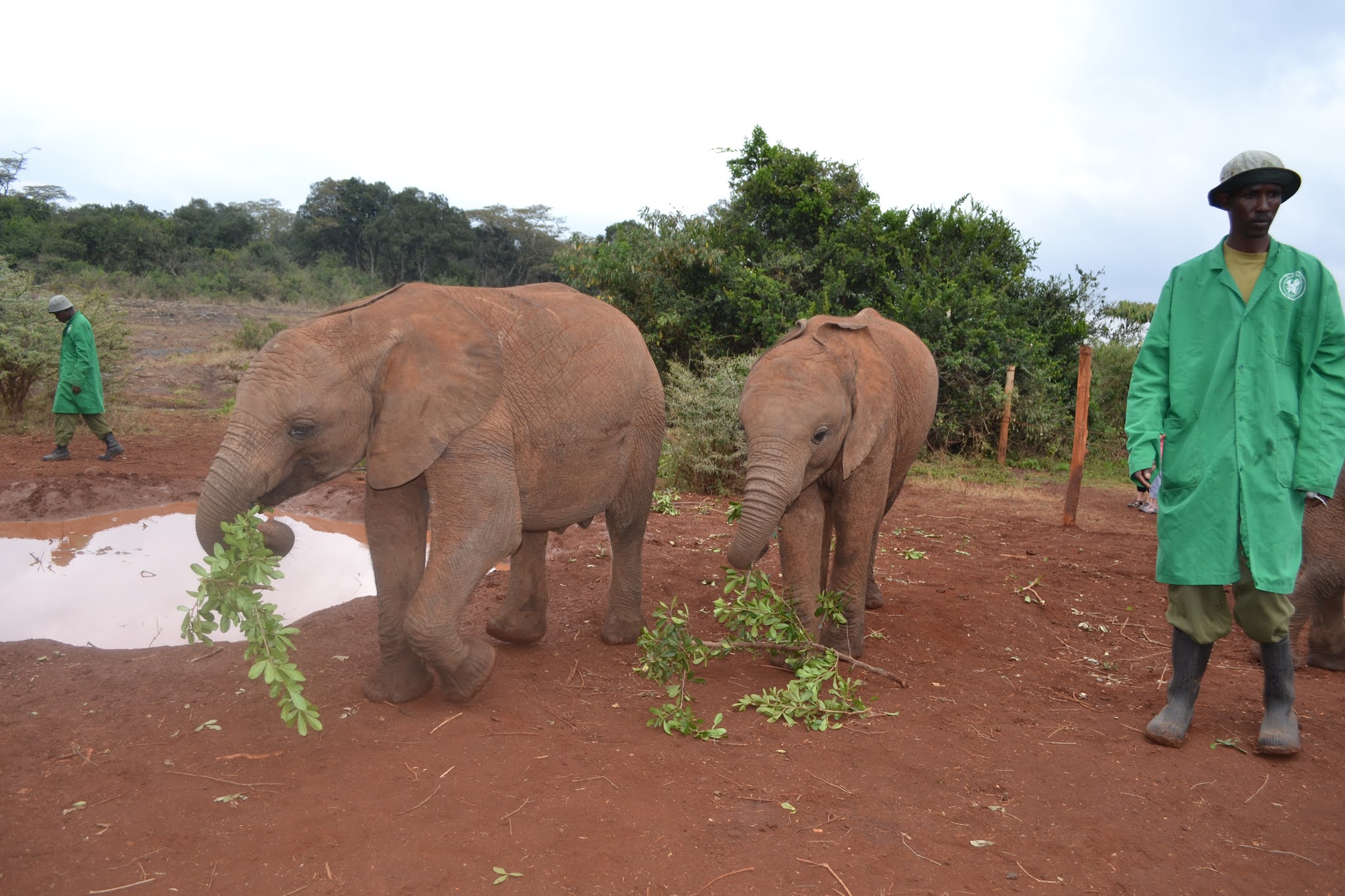
Soon elephant babies started arriving from stockades in batches. Seniors were first to arrive and were followed by the little ones. They all rushed for the feeding bottles of milk. They were helped by the keepers wearing green color overalls. Nearly thirty orphaned elephant babies, of different age, entered into the arena.

Keeper with babies

Little ones needed more help as they were yet to master the skill of holding those bottles with their tiny trunk. Keepers helped them by holding the giant feeding bottle upside down into their mouths. 

However, little grownups were skillful enough in holding the bottles just upright.

Happily 'drunk'

They gulped the milk and a few of them chased the keepers asking for more milk. It was a heavenly scene to watch.

Human parent

While the drinking session was on, very small and cute two babies, accompanied by their keepers, wrapped in bright red and black blankets arrived last. The man in green overall, with a portable mike hanging on his shoulder, announced that one of them was Kamok, the youngest baby. She was incredibly small in size, compared to other baby elephants. She followed her keeper very closely, oblivious of the present audience who were admiring her.


Fight for fun

After they drank milk, it was the time for them to play. They chewed the leaves from the twigs strewn around, played with mud and water. Male calves got into mock fights with others. Boys will be boys! 

Mud bath

It was indeed an extraordinary feeling to watch so many elephant babies playing at one place.

Enjoying mud bath

It continued for nearly one hour.

Mud bath - full enjoyment

Once the clock struck 12 noon they left for their stockades in batches with their keepers, like they had arrived. 

Leaving for stockades

Gradually all of them vanished behind the green curtain of the forest leaving empty milk bottles scattered all over the place.

Vanishing step

At the end of the show, spectators left for the main gate and I went to the office of David Sheldrick Wildlife Trust. There, I completed formalities for fostering Kamok. The process was simple and quick. The required forms were filled in and annual fee was paid for fostering. We became foster parents for Kamok. A certificate, in this regard was issued separately.

As we could not bring our fostered daughter Kamok back home to India, we left her with her keepers, as per procedure, who are experts in handling such children. She would remain at the nursery and gradually get ready for reintegration with wildlife at appropriate time.

The objective of David Sheldrick Wildlife Trust was not to domesticate the orphaned elephant babies but to rear them in such a fashion that in due course of time they could go back to the wilderness. This process of integration of orphaned traumatized babies back to wildlife was a very tedious and time consuming one. Average time frame for reintegration of a baby with normal wild life was ten years. However, the time scale varies depending upon several factors viz. the age and stage at which the baby was orphaned, their abilities to manage themselves without human keepers, willingness to lead independent lives etc.  

Till such time they live at David Sheldrick Wildlife Trust, all expenses were borne by the trust. Large funds were required to meet all kinds of expenditures – food, medicines, rescue, accommodation, transport etc. Donations raised through the way of fostering the kids were utilized in this noble cause. Angela, daughter of Daphne had introduced this unique concept of fund raining through liberal fostering scheme. Minimum contribution was US $ 50.00 per annum and there was no upper limit. One person could foster more than one baby. Also, several persons could foster an individual child. Like me, there were several others parents across the globe fostering Kamok simultaneously.

4.0 Fast forward:

On 7th September 2016, Kamok became three years old, fit and fine. She has grown naughty as well. It was the right time that she would leave the nursery for two reasons. Firstly, she would prepare herself for next stage towards reintegration in the wildlife and secondly, to create space at the nursery to accommodate newer orphans.

So, the decision was taken that Kamok would be relocated to Ithumba Relocation Unit of Tsavo East National Park. Accordingly, December was chosen as the ideal time for her relocation. In the month of December, monsoon would recede from Kenya leaving behind the Tsavo forest covered with green foliage. Waterholes would be full up the brim and rivers overflowing with water. Thus, there would be plenty availability of food and water for relocated elephant babies.

Accordingly, on 28th December, 2016 Kamok along with two other orphan babies Roi and Oltaiyoni were woken up at 3 am at their stockades. They were given mild sedatives, as preparation for tension free ensuing journey. All of them were loaded in a specially designed truck along with their keepers and were sent off to Ithumba Relocation Unit. The journey commenced in the darkness of night and by 10:30 am they were at the destination. Interestingly, they were received by Dr. Daphne, accompanied by Angela, Robert, Taru and Roan.  

Today, nearly five years have passed, since her arrival to Ithumba Relocation unit. She has accepted her new abode and has mingled well with other orphans who have arrived prior to her. Her daily routine involved going to the forest area and browse with other elephant babies - Siangiki, Enkikwe, Barsilinga, Sirimon, Lemoyian to name a few. She still remained fond of milk bottles and mud bath as well.

From reintegration center, one day Kamok would join the elephant community of the Tsavo National Park. As a foster parent, we pray to God that she should go back to the wild, as early as possible, where she belongs. We dream for a day when adult Kamok would embrace motherhood in the forest and would visit the reintegration center to show off her baby girl to her human keepers as was done by many orphaned elephants in the past.


Webliography:

https://www.sheldrickwildlifetrust.org

https://www.sheldrickwildlifetrust.org/asp/orphan_profile.asp?N=299

https://www.sheldrickwildlifetrust.org/asp/fostering.asp

https://www.sheldrickwildlifetrust.org/updates/updates.asp?Rhino=&ID=985

https://www.telegraph.co.uk/news/earth/9100415/The-woman-who-fosters-elephants-in-Kenya.html


Disclaimer:

The information provided in the article is for general informational purposes only. All information is provided in good faith. This is only for the sharing of knowledge of Philately with philatelist fraternity. No commercial angle, whatsoever, is involved. Under no circumstances I shall have any liability for reliance on any information provided in the story.

Friday, 17 September 2021

A Forest Bound Daughter (Part I)

An orphan calf drinking milk

Prelude to Part I:

The story of our adopted daughter - Kamok, is being presented in two parts. This is first part which deals about her journey from forest to nursery. Second part will unfold about her preparation for reverse journey i.e. from nursery to forest, and forever. May like to read on.

1.0 Preparation:

It was a cloudy morning of 1st of December at Nairobi. I had set out in search of a beautiful Christmas gift for my better half Sonali Sen Biswas. The gift should be too precious to give as well too unique to receive. However, instead of heading for a shopping mall (mind it that nearly two months back a terrorist attack had claimed several innocent lives at the Westgate Mall of the city), I drove towards Nairobi National Park of Kenya (Eastern Africa). Incidentally, Nairobi National Park is the only national park within a city in this whole world. Under this early cloud masked sky my destination was David Sheldrick Wildlife Trust (DSWT). 


Welcome board

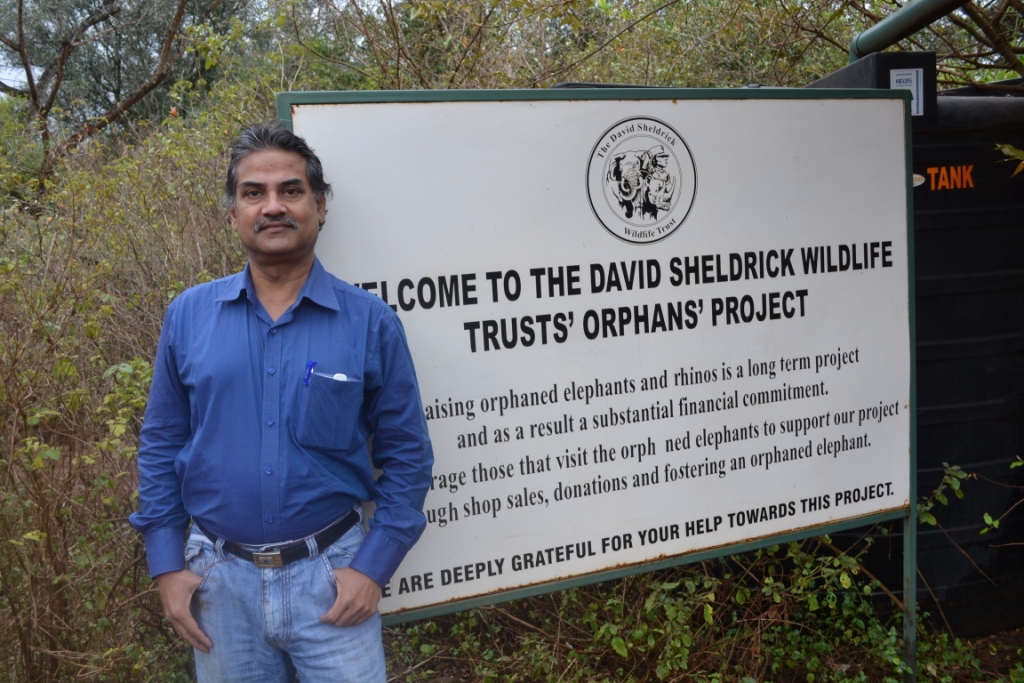
David Sheldrick Wildlife Trust was founded by Dr. Dame Daphne Sheldrick D.B.E, in the year of 1977, in the fond memory of her late husband David Leslie William Sheldrick MBE. He was the founder warden of Tsavo East National Park, Kenya. Later, David Sheldrick Wildlife Trust was incorporated as a Charitable Company in the U.K. (2004). Angela Sheldrick, the younger daughter of David and Daphne, was actively involved with activities of David Sheldrick Wildlife Trust since her childhood. After sad demise of Dr. Daphne (13th Apr 2018) at the age of 84 years, the operations and running of trust is being looked after by Angela, her husband Robert Carr-Hartley, and their two sons Taru and Roan.


One hour window

In this month of December, the sky was overcast with moisture laden cloud. There were intermittent rains, sometimes there was drizzle and occasionally heavy downpour. The watery precipitation from sky was sometimes gentle while sometimes violent with gusto. In this not-so-tourist-friendly weather I reached my destination at around ten o’clock in the morning. The milk drinking session of elephant babies of the nursery of David Sheldrick Wildlife Trust would commence daily (excluding the day of Christmas) at 11 am and would close down for visitors by 12 o’clock (local time). The orphanage would open to the visitors only for one hour daily. During one hour session, elephant calves would come in front of the visitors for their share of milk, mud play etc. Because of that reason, there were constant reminders from my local Kenyan driver-cum-guide that I should not be late.

At David Sheldrick Wildlife Trust, orphaned baby elephants (mostly victim of human-wildlife conflicts, poaching etc.) would be brought after rescue, reared till they matured enough for release in the wilderness. However, the expenses were prohibitive as it involved long term commitment.


Milk feeding bottles

Like any other day, on my day of visit too, there were many visitors from different corners of the world to witness the one hour playful session by the pachyderm babies. Entry fee was US$ 7.00 or 500 Kenyan shillings per person. Entry fee was levied and fostering contributions were received by the trust to raise the fund which was used for several purposes. Some of the expense heads were rescue operations, construction and maintenance of stockades/stables for the kids, logistics and transport, milk and food for these baby giants, medicines etc. and though last but not the least was the housing and salaries for the committed local keepers. In other words, till such time the orphaned baby was reintegrated to the wilderness, all requirements were taken care by the trust.

I paid the entry fee and walked through the red colored muddy track towards the arena where orphaned baby elephants would be coming for their share of milk. I also informed the office of David Sheldrick Wildlife Trust that I would be fostering one baby. The selection criteria were – a female child and youngest of the lot. That would be my Christmas gift for that year to my wife.


The certificate

2.0 Flashback:

It was early morning of 8th September 2013. The villagers of Kiparo Boma (livestock enclosure) on Ol Pejeta Conservancy in Laikipia, Kenya woke up hearing some unusual sound. To their utter surprise, they found that outside there was a newly born (one day old) elephant calf desperately looking for her mother for food and comfort. Villagers immediately fanned out in the nearby forest area to find the elephant herd where from they presumed the baby might have got separated.


Kamok during early days (Source: Sheldrick Trust website)

But all in vain.

In spite of their best efforts, villagers could not trace out any elephant herd nearby to get her reunited back.


A baby drawn by milk bottles

They immediately contacted David Sheldrick Wildlife Trust at Nairobi. On getting the emergency call, the rescue team of the trust swung into action. The team with all necessary rescue apparatus and paraphernalia was airborne from Nairobi. It was flight of 40 minutes from Nairobi to Ol Pejeta airfield. On landing, the rescue team found that Ol Pejeta Scouts have already brought the baby from Kiparo boma to the runway of the airfield.


Rushing for milk bottles

The baby was hungry, exhausted and frightened. The team immediately gave her a bottle of milk, a substitute of milk of mother elephant which was developed by Dr. Daphne. Mother’s milk is very important for the first two years for the baby elephant for survival. After three decades of trial and error, Dr. Daphne was successful in developing an alternative of mother's milk for elephant and rhino calves. This substitute has helped in saving many lives of nectar dependent unfortunate orphaned babies of elephants and rhinos. Her expertise in hand rearing milk dependent new born elephant and rhino calves have saved lives of more than 230 orphaned elephants in Kenya. Besides, many more such helpless babies without mothers have survived through her knowledge sharing in Africa and India.


Feeding the kids

Meanwhile, the trained members of the team wrapped the child with blanket for comfort. They helped the calf to board the aircraft and she was put on drip for return journey.

On arrival at the nursery of the trust, where expert veterans were eagerly waiting for them, the health of the baby was checked. It was found that her limbs were compromised at the birth. Because of that reason the poor creature could not match with the movement of the herd. As per the unwritten rule of the wild, a new born elephant baby should be able to walk 20+ kms within 24 hours of birth. Since she could not, she was left behind by her own mother and herd. Though elephants are strongly family oriented, they take such decisions when the risk was envisaged for the entire herd.

Kamok, wrapped in blanket

While experts looked after her for well-being and treatment, the pertinent issue came up for a suitable name. The trust has a system to assign a name to the rescued baby in sync with the location from where it was found, to trace the origin. Thus she was named as Kamok, a name which was taken from the Ol Pejeta ranch.

A closeup of Kamok

With the passing of time, two major improvements were noticed. Firstly with the help of medications and care her wobbly legs got strengths and secondly she became closely attached with her keepers which were healthy signs for rearing a baby without mother. Because of separation anxiety from mother, at times such orphaned babies would go into depression. They would refuse food intake. In such situation it would become difficult for the trust to save the child. However, with God’s grace, Kamok grew playful, started playing with sand and red soil which were in abundance in the locality. Off late, she was found experimenting with her little and cute trunk. She began following her keepers to the bushes and other areas with other orphaned babies.

Here is the link of her rescue:
https://www.sheldrickwildlifetrust.org/orphans/kamok

End of Part I. Continued to Part II.

Webliography:

https://www.sheldrickwildlifetrust.org

https://www.sheldrickwildlifetrust.org/news/updates/the-resuce-of-kamok

https://www.sheldrickwildlifetrust.org/asp/orphan_profile.asp?N=299

https://www.sheldrickwildlifetrust.org/asp/fostering.asp

https://www.sheldrickwildlifetrust.org/updates/updates.asp?Rhino=&ID=985

https://www.telegraph.co.uk/news/earth/9100415/The-woman-who-fosters-elephants-in-Kenya.html

Disclaimer:

The information provided in the article is for general informational purposes only. All information is provided in good faith. This is only for the sharing of knowledge with global reader fraternity. No commercial angle, whatsoever, is involved. Under no circumstances I shall have any liability for reliance on any information provided in the story.

Sunday, 15 August 2021

Forodhani Garden of Zanzibar Island


Sunset from Forodhani Garden, Zanzibar

In the Sun kissed romantic island of Zanzibar, Forodhani Garden is a jewel in the crown of Stone Town.  It is a beautiful garden. It is also a lovely park with open water front. Its name is Forodhani Garden or Forodhani Park. In Swahili language Forodhani means 'Customs'. The original Zanzibar Customs House was located close to the Park wherefrom the name Forodhani Park might have been originated.

It is also called Jubilee Park.  The name Jubilee Park was derived from the fact that the park was created in 1935, at the time of the 25th anniversary of the coronations (06 May 1935) of His Majesty King George V and Sultan Khalifa of Zanzibar, who ruled Zanzibar from 9th December 1911 to 9th October 1960.

Sultan Khalifa bin Harub of Zanzibar

It is sandwiched between the remains of formidable old fort and Indian Ocean. On the shore side there are high walls of old fort which once protected the island from sea invaders and controlled the sea route business. One can wonder about the House of Wonder, located right across the road. On the other side, the boundary is demarked by the waves of Indian Ocean. A visit to the Forodhani Gardens offers a stroll on the walkways along the garden path.

First Day Cover by Tanzania Post

Though the garden was in existence since long, it was given a facelift by Aga Khan Trust for Culture (AKTC). The Aga Khan Trust for Culture (AKTC) was founded in 1988 with registered office at Geneva, Switzerland. As an agency of Aga Khan Development Network (AKDN) it works to uplift and for the welfare of poor and downtrodden people, especially those living in the continents of Africa and Asia. Aga Khan's benevolent and generous donations came forward for the renovation work of the Forodhani Garden, as it provided livelihood of many poor families. This is in line with the principle of AKTC for socio-economic and cultural revitalization of Muslim community.

Renovation work was done as a part of 1994 Conservation Plan which spanned three areas viz. Kelele Square, Forodhani Park and Mizingani Seafront. The initial project cost for renovation of Forodhani Park alone was estimated to be US$ 2.4 million but at the time of completion (2008 – 09) it had exceeded US$ 3.0 million. Aga Khan did a ground breaking ceremony on the auspicious day of 31st July 2009 for its renovated look.

The original design of the park was retained while a few new fittings and fixtures were added during the course of restoration work. For example, the lighting of the park was in the design of cast iron lamps which were then brought from Glasgow. 

Silhouette of Bandstand

At the center of original Jubilee Park there was a Bandstand and a white concrete arabesque arch nearby which was erected in the year of 1956 in the honor of visiting her Highness Princess Margaret. 

Bandstand on a postage stamp of Tanzania Post

Those were restored as per original design. The dome at bandstand adds charm in between the green expanse of the park. Palm trees were planted in the spaces among the original geometrical designs of fountains and bandstand. Work included new ornamental landscaping, paving of walkways, improved drainage system, civic amenities like sewerage and garbage disposal.

One can visit the garden at any part of the day. The flower beds in the garden with light and shade of big trees is something special for the tourists who love serenity and quietness.

Cannons and Cats

Cannons, which spewed fire in their glorious years, were left in disuse to decay. However, they were restored and reinstalled on the shore line as six-cannon battery. 

Six pack series


Today, tourists can sit by the side of these lethal but sleeping beauties, can touch them and can feel the history attached to them. Sitting by the cannons of yesteryears at the promenade and watching the endless water of Indian Ocean can turn anyone into a poet. 

Dividing line of horizon

The idyllic beauty of the sea front with sailing boats, ranging from traditional boats to mechanized catamarans is a scene to be enjoyed. Watching sunset across the vast ocean is mesmerizing.

Sunset across an island

There is another interesting activity to watch out at the sea front near the time of sunset. A group of teenager local boys appear from nowhere. They indulge in diving and swimming in the water of Indian Ocean. Like sprint runner, they would start running from the shore towards the water and after crossing the barrier stone wall their body would float in air till it splashes in the water. Some would dive straight into the water. A few would perform somersault in the midair before plunging in the water. They would swim back; climb the stone wall to repeat the exercise. It is a great fun to watch them performing such acrobatics movements. These young divers do it only for fun to outsmart each other in a friendly competition. There are two specialties about this fun game. Firstly it is boy’s sport and secondly it appeared to be in promptu, as the divers were arriving in all kind of dresses but swimming trunk!

Fun at waterfront

Though the park is open throughout the day, people normally throng at the park in the evening. Local ladies in their colorful dresses add color to the twilight rays of setting Sun. A park in the day time turns into an open air food court, every day throughout the year. It is an interesting metamorphosis of the park only for a few hours in the evening, from evening to around 10 pm. The atmosphere is like a carnival with plenty of food items. The park is quite big, yet at times there may be overcrowding, particularly during the festive seasons like Eid holidays and others long weekends.

Temptation!

An amazing out of the world experience is assured at the evening food court. If you like street food then this is the ultimate place. Ambience is incredible with mind boggling array of local fast food. Locals and foreigner tourists rub shoulders with each other to grab a bite of the fast food offered by the vendors. 

Gastronomic galore

Majority of the stalls offer similar menu but that is not an issue till you zero down to one stall (to start with) based on your instinct. Afterwards, you can tickle your taste buds with various tastes at the stalls of different vendors. Price is reasonable. Food is cooked right in front of you.  As darkness sets in, the aroma of cooked food overpowers the hypnotic scents of the flowers of the garden. Aroma of fresh cooking wafts in the air and mingle with salty moisture carried by the sea breeze from Indian Ocean.

Food stalls in a row

Interestingly all the chefs don professional attire starting from apron to cap. Stalls sell potato chips, samosas, cutlets, chapatis, chicken Shawarma and endless variety of Zanzibar Pizzas. There is Nutella Pizza too. Though they are called pizzas, they are no way even distant cousin of Pizzas. The ‘manufacturing process’ is somehow a bit similar to Mughlai Parantha of India!

Zanzibari Pizza Preparation

Samosas too are different from Indian counterpart. Though they are triangular in shape and have pyramidal look, they are relatively flat around the center. There are varieties too viz. veg samosa, beef samosa etc.

Bread basket

There are stalls that specialize in local cuisine, both of Swahili and Zanzibari varieties. These stalls can be easily distinguished from the others from the distinctive crowd of local buyers.  These stalls offer cow soup, kuku chips (grilled chicken with French fries), chipsi mayai (omelet with French fries), Mishkaki (sheek or sheesh kebab), chipsi and mishkaki (French fries with a small kebab of beef or chicken), Urojo (soup with potato balls), pilau (pulao or spiced rice) etc.

Crabs and claws!

Climber crabs of Zanzibar

Array of sea food is simply mind boggling. Food stalls are stacked with crabs, shrimps & lobsters, squids & octopuses, and many varieties of fishes.

Kalamari, crab and corn

Tables are laid with lobster claws, tentacles of octopuses, fishes with yawning open mouth etc. All the vendors claim that the seafood is fresh. However, there are some elements of doubt. Even for certain items, re-heating is done in the name of cooking.

Favorite fruits 

Vegetarians need not worry. Though not plenty, compared to non-vegetarian stuff, they have ample choice of menu like grilled sweet potatoes, bananas and puffy coconut bread.  

Sugarcane juice punch

Though alcohol flows freely in every nook and cranny of Zanzibar, it is not allowed inside the garden whatsoever may be the reason. However to quench the thrust fresh sugarcane juice, extracted through age old hand operated turn wheel machines, right in front of you, is readily available. 

Hand operated sugarcane juice extraction machine

One can add pinch of additional sugar and punch of lime juice or ginger juice as per choice. At the end, one can have Sweet Zanzibar Pizza as desert to satisfy sweet tooth.

Welcome back again

These foodstuffs are not recommended for those who are health and hygiene conscious. Not all the stalls maintain highest level of cleanliness and quality. Some of the food served may be partly baked and not properly cooked, particularly at the time of peak business. A few have complained about falling sick afterwards and have blamed it on the poor quality of food. However, complainants are only a few while hundreds visit and eat food every day. After all those who savor street food they are willing to experiment with such delicacies with certain degrees of risk factor. Probably it is worth.

********

Disclaimer:

The information provided in the article is for general informational purposes only. All information is provided in good faith. This is only for the sharing of knowledge of Philately with philatelist fraternity. No commercial angle, whatsoever, is involved. Under no circumstances I shall have any liability for reliance on any information provided in the story.


Narain Niwas Palace Hotel – A Heritage Hotel at Jaipur, Rajasthan, India

  Narain Niwas Palace Hotel Imagine about India before 1947, a mosaic of glittering princely states ruled by majestic kings, queens, rajas, ...