Contact form

Name

Email *

Message *

Saturday, 2 September 2023

Petroleum Philately of India: Guwahati Refinery


Petroleum: Formed millions of years ago, from organic matters, under the crust of earth, through natural high pressure and extreme temperature.  Archaeological findings indicate the use of raw petroleum in the days of Pharaohs. In twentieth century and till date, it has become a mighty industrial force to be reckoned with. Its application ranges from illumination to cooking to many others. The modern civilisation is catapulted by and also till date is driven by petroleum oil and its derivatives. Complex hydrocarbons are broken down through refining processes to produce petrol (gasoline), diesel (gas oil), naphtha, aviation fuel, and petrochemicals etc. Natural gas is also found along with petroleum deposits which serves both as fuel as well as feed-stock for several industries.

In recent times, petroleum has turned to be the cause of war and it also happened to be the main driving force of machineries of warfare. On one hand, it has provided several advantages to mankind say greater mobility etc., on the other hand it is the root cause of geopolitics and global warming. The worst part is that hydrocarbons being the chief constituents, it is primarily responsible for carbon emission.

Philately: A hobby of collection and study of postage stamps and allied materials.

Petroleum philately: A special branch of thematic or topical philately, which deals exclusively with petroleum related philatelic materials.

Petroleum philatelic materials: These are postage stamps, revenue stamps, souvenir/miniature sheets, mini-sheets, My Stamps, First Day Covers, Special Covers, aerograms, inland letters, postcards, picture postcards, labels/panes etc., and have images / pictures / sketches, postage marks, franking marks, logos, USPs, trademark etc., on petroleum oil, natural gas and petrochemicals. It spans entire value chain of petroleum industry ranging from prospecting, exploration and production, refining, storage and transportation, distribution and marketing, research and development, to the end-use. Under its gambit, there are personalities, ranging from scientists to industrialists to oil barons, related to the said industry, business and regulatory entities, and a much more. Related occupational hazards and safety issues are also included. Though last but not the least, oil conservation and concern for environment are featured too.

My Stamp - Guwahati refinery

My Stamp: It is a personalised postage stamp issued by India Post. A sort of se-tenant type of pair where one part is the postage stamp and the selvage part may have a company's logo, picture etc. The face value of a stamp is INR 5. The price is INR 300 per mini sheet. One mini-sheet contains 12 stamps and they can be used by post. Any individual can have her/his My Stamp with photograph from India Post for INR 300. This was introduced during World Philatelic Exhibition (INDIPEX 2011) held in New Delhi during 12-18 February 2011. It has become popular for Indian corporate and business entities. For bulk order, the minimum number of My Stamp Sheets to be ordered is 5,000. Thus, the minimum cost for one corporate My Stamp is INR 1,500,000. However, it has caught the fancy of corporate houses as it is a great publicity material. So far, with the issue of about 225 My Stamps for various organisations, India Post has generated revenue worth nearly INR 340 million.

Full sheet of My Stamp

My Stamp of Guwahati refinery of Indian Oil Corporation Limited was issued on 03 August 2023, on the occasion of Diamond Jubilee (60th glorious years) of successful operation of the refinery.

---------------------------------------------------------------------------------

The very first petroleum themed commemorative postage stamp on Indian petroleum industry was issued on 01 January 1962 on ‘Gauhati’ (changed later as Guwahati) refinery.

The first petroleum stamp of India

This particular stamp has several ‘firsts’ in its credit:

1.First petroleum stamp of India

2.Based on first public sector petroleum refinery in post-independence period

3.Released on first January of the year 1962

4.The refinery was dedicated to the citizens of India by Jawaharlal Nehru, the first Prime Minister of independent India on first day of the first month of 1962

Doesn’t it sound incredible!

It may not be out of point to mention that first petroleum product pipeline in India was laid from Guwahati refinery of the state of Assam to Siliguri of the state of West Bengal.

During pre- and post-independence era, petroleum oil business in India was under control of foreign oil companies viz. Standard Oil Company, Esso, Caltex, Burmah Oil Company etc. Since oil was of strategic business, Government of India incorporated Indian Refineries Limited on 22 Aug 1958. With an authorized capital of INR 30 crores, it was assignied the task of setting up of two oil refineries, one each at Guwahati, Assam and at Barauni, Bihar and also oil pipelines. Firoz Gandhi was appointed first Chairman (1958–1960) of Indian Refineries Limited .

Subsequently, another purely national oil enterprise called Indian Oil Company Limited was incorporated under Companies Act 1956 on 30 June 1959, in order to look after the oil marketing activities. Indian Oil Company Limited was entrusted with responsibilities to market petroleum products that would be produced by two refineries, under construction by Indian Refineries Limited, one each at Guwahati and Barauni. S Nijalingappa was the first Chairman (1959–1962) and B Arora was the first Managing Director of Indian Oil Company Limited.

In order to integrate the supply chain and bring synergy, in Sept 1964, Indian Refineries Limited was dissolved and merged with Indian Oil Company Limited. The new entity was named as Indian Oil Corporation Limited - a 100% Indian company was born. P. A. Gopalakrishnan was appointed as the first chairman (1964–1966) of Indian Oil corporation Ltd. .

Indian Oil corporation Ltd., established the refinery at a place called Noonmati in Guwahati, on the bank of mighty river Brahmaputra. It is spread over an area of 147 acres of land. The refinery was constructed with Romanian collaboration. The refinery processes petroleum crude oil, exclusively of Assam origin, produced by companies like Oil India Ltd., and Oil and Natural Gas Corporation Ltd. The initial capacity of the refinery was 0.75 million metric tonnes per annum (MMTPA). The refining capacity was enhanced to 1.0 MMTPA in 1986. The capacity is expected to be expanded further to 1.2 MMTPA during the current year 2023. Presently it produces LPG, naphtha, petrol (gasoline), kerosene. aviation fuel, gas oil (diesel), and coke (raw and calcined).

However, the production of refined products by the refinery was in excess of local demand. Later on, Indian Oil Corporation Ltd., laid Guwahati - Siliguri pipeline of 435 km of length and capacity of 1.4 million metric tonnes per annum for movement of refined products from refinery to the demand centres, outside the state. 

On 01 January 1962, the refinery was dedicated to the nation by Jawaharlal Nehru. A commemorative stamp was issued on the occasion.

The first petroleum theme stamp of India

The interesting part in the design of the commemorative stamp was depicting a one-horn Indian Rhinoceros (Rhinoceros Unicornis), along with refinery complex. Rhino is the state animal of the state of assam which reflects its rich natural treasures. The creature is a threatened species. It has been listed as vulnerable on IUCN Red List. 

One-horn Indian Rhino

During his royal visit in December 1911, George V went for a hunting trip to Nepal. In the said hunting party, His Highness was accompanied by Maharaja of Nepal. A total 18 number of defenceless rhinos were killed by the elephant mounted hunting team. In the old photograph, both the dignitaries could be seen seated in their howdahs, on elephant back.

Source: Internet

Once upon a time, Indian rhinos were found in abundance in Indo-Gangetic Plain. However, due to overhunting, poaching, loss of grassland, habitat etc., the number of this otherwise gentle herbivore creature, has dwindled. 

In the bygone era of Indian Maharajas and Nawabs, the organised fight among animals was a way of entertainment for riches and nobles. The fights between two elephants or a pair of rhinos etc., were hosted with much fanfare. While the owner of the winning side would receive prize money, the defeated and injured animal would left to die. A fighting of rhinos, hosted by Maharaja of Baroda, during the visit of H.R.H Albert Edward, Prince of Wales to India (November 1875 - January 1876).

Horns of dilemma (Source: Internet)

During 2000-2006, more than 150 rhinos have been killed by the poachers in Assam. In Assam, rhinos are found in Kaziranga and Manas National Park, and a few other places. About 85% of Indian rhinos of the world are located in Assam. Moreover, 70% of the rhino population has been concentrated in Kaziranga National Park which itself is a big risk for the animal. However, the process of conservation and creation of awareness among local dwellers are yielding positive results.

A Special Cover was issued on 50th year

Availability of crude petroleum oil in the state of Assam was found in 1825 by the British authorities. 

A Special Cover issued on 60th year - with My Stamp

The discovery of an oilfield in Naharkatiya, Assam in 1953, prompted the government to set up a refinery for proper processing of the crude oil. 

A Special Cover issued on 60th year - with stamp on Indian Oil

Reverse of the special cover

A tug of war began between the central government and state government of Assam. Central government wanted to set up a refinery outside the state boundary while people of Assam wanted it within the state. It took the shape of matter of prestige and honor of the people of Assam, resulting in statewide agitation. 

The story unfolded like this.

For refining of newly found Assam crude, central government proposed Barauni, Bihar as suitable location for setting up a new refinery. Assam Oil Company preferred Calcutta (now Kolkata) of the state of West Bengal as the location of refinery. There were justifications for both locations. Barauni scored brownie points because after processing, finished products could be used to meet the demand of petroleum products of eastern and part of northern India. The port facilities of Calcutta port were a gateway for coastal evacuation of refined products. That was its plus point. On the other hand, a strong demand for local site was raised by local population as well as politicians. 

As the matter started heating up, in the year 1956, the All-Assam Oil Refinery Action Committee (AAORAC) was constituted by the local people to press for the demand of local refinery. It spearheaded the agitation demanding that the refinery to process Assam crude must be set up in Assam. It was a long-drawn people's movement which spanned from 1955 to 1957.  Schools, colleges, shops, government offices etc., were frequently shut and picketing by the students was a common sight. So was the law-and-order situation with frequent street fight between agitators and law enforcing authorities.  It was a very much heard slogan chanted by the student activists:

"Ami tez dim kintu tel nidiu." (We shall give blood but not oil.)

At one point of time, Jawaharlal Nehru was forced to comment:

“The question of refinery in Assam could not be resolved through violence; it should be decided only on the basis of feasibility”.

To find an amicable solution, in September 1956, an eleven-member Expert Committee was formed by the central government. S Basistha, the then Advisor to Ministry of Railways was appointed as head of the committee. There was one member, each from Romania and France in the committee too. Incidentally though were representatives from Assam Oil Company in the committee, no member from government of Assam was taken onboard. Jawaharlal Nehru visited the state on 18 October 1956 and he faced the anger of public. 

The first Prime Minister of India - Jawaharlal Nehru

People lined up the road through which he passed. They shouted slogans and hold placards. Some of the slogans read:

"Tel Sodhanagar Asomot Laage, Asomor Udyogikaran Hoboi Laagibo, and Asomor Daabi Maaniboi Laagibo.

(The oil refinery must be in Assam; Assam must be industrialised and the demand of Assam has to be recognised)."

In June 1957, the central government concluded that Barauni would be the most suitable place for processing of Assam crude. It goes without saying this decision added fuel to the already raging fire. Oil Refinery Action Committee began preparation for mass movement. All Assam general strike was observed in the state on 29 July 1957. Everything in the state came to a grinding halt. Several agitators were arrested but the spirit of the people remained high. The central government appointed Foster Wheeler as a consultant to find out a solution and to end the agitation. Finally, government decided and announced that instead of one refinery, there would be two refineries, one each at Barauni, Bihar and at Noonmati, Assam. Subsequently, the agitation in Assam was withdrawn. 

The Indian government entered into an agreement with government of Romania to establish a refinery in Assam. The government of Romania provided a soft loan of INR 5.6 crores to Indian government, at an interest rate of 2.5%, repayable in phases. The total cost of construction of the refinery was estimated as INR 17.7 crores. Romania provided technical knowledge, did engineering design, imparted training to Indian engineers (several went to Romania for hands-on exposure). Actual construction was done by Indians under the guidance and supervision of Romanian experts. Equipment and machineries of about 18,500 tonnes were shipped through marine route from Romania, landed at Kolkata (then Calcutta) port and moved upwards to Noonmati project site of Guwahati.

The refinery was finally set up in Guwahati, Assam. Another refinery came up in Barauni, Bihar but that is a different story.

The certificate

It will not be out of point to mention that my petroleum philatelic collection 'Assam - The Maternity Block of Indian Petroleum Industry', under invitee category, was exhibited during ASSAMPEX-2022, the 4th State Level Philatelic Exhibition of Assam, held at Guwahati. A certificate and a trophy were awarded.

Webliography:

https://iocl.com/pages/guwahati-refinery

https://webology.org/data-cms/articles/20220324065610pmwebology%2016%20(1)%20-%201%20pdf.pdf

Disclaimer:

The noble objective of this blog, is to promote the hobby of philately through images of stamps, a few pictures and related narration. The scans of My Stamp, featured in this blogpost are mine while others (sourced from internet) are the properties of their respective owners. No intention to infringe any type of copyright. 

The information provided in the article is for general informational purposes only. All information is provided in good faith. This is only for sharing of knowledge of philately with philatelist fraternity of the world. No commercial or political angle, whatsoever, is involved. This is not a historical document. Apologies in advance, should there be any inadvertent mistake or error. Under no circumstances, I shall have any liability for reliance on any information provided in the story.

***********


Saturday, 26 August 2023

Petroleum Philately of India: Panipat Refinery

Panipat Refinery My Stamp of Indian Oil Corporation Ltd.

Petroleum: Formed millions of years ago, from organic matters, under the crust of earth, through natural high pressure and extreme temperature.  Archaeological findings indicate the use of raw petroleum in the days of Pharaohs. In twentieth century and till date, it has become a mighty industrial force to be reckoned with. Its application ranges from illumination to cooking to many others. The modern civilisation is catapulted by and also till date is driven by petroleum oil and its derivatives. Complex hydrocarbons are broken down through refining processes to produce petrol (gasoline), diesel (gas oil), naphtha, aviation fuel, and petrochemicals etc. Natural gas is also found along with petroleum deposits which serves both as fuel as well as feed-stock for several industries.

In recent times, petroleum has turned to be the cause of war and it also happened to be the main driving force of machineries of warfare. On one hand, it has provided several advantages to mankind say greater mobility etc., on the other hand it is the root cause of geopolitics and global warming. The worst part is that hydrocarbons being the chief constituents, it is primarily responsible for carbon emission.

Philately: A hobby of collection and study of postage stamps and allied materials.

Petroleum philately: A special branch of thematic or topical philately, which deals exclusively with petroleum related philatelic materials.

Petroleum philatelic materials: These are postage stamps, revenue stamps, souvenir/miniature sheets, mini-sheets, My Stamps, First Day Covers, Special Covers, aerograms, inland letters, postcards, picture postcards, labels/panes etc., and have images / pictures / sketches, postage marks, franking marks, logos, USPs, trademark etc., on petroleum oil, natural gas and petrochemicals. It spans entire value chain of petroleum industry ranging from prospecting, exploration and production, refining, storage and transportation, distribution and marketing, research and development, to the end-use. Under its gambit, there are personalities, ranging from scientists to industrialists to oil barons, related to the said industry, business and regulatory entities, and a much more. Related occupational hazards and safety issues are also included. Though last but not the least, oil conservation and concern for environment are featured too.

My Stamp: It is a personalised postage stamp issued by India Post. A sort of se-tenant type of pair where one part is the postage stamp and the selvage part may have a company's logo, picture etc. The face value of a stamp is INR 5. The price is INR 300 per mini sheet. One mini-sheet contains 12 stamps and they can be used by post. Any individual can have her/his My Stamp with photograph from India Post for INR 300. This was introduced during World Philatelic Exhibition (INDIPEX 2011) held in New Delhi during 12-18 February 2011. It has become popular for Indian corporate and business entities. For bulk order, the minimum number of My Stamp Sheets to be ordered is 5,000. Thus, the minimum cost for one corporate My Stamp is INR 1,500,000. However, it has caught the fancy of corporate houses as it is a great publicity material. So far, with the issue of about 225 My Stamps for various organisations, India Post has generated revenue worth nearly INR 340 million.

-------------------------------------------------------------------------------------------------------------
The name of Panipat reminds one about the historical background of a location in India where three fierce battles were fought and which had changed the political course of the country.

The first battle of Panipat (Courtesy: Wikipedia & Baburnama)

The First Battle of Panipat was fought on 21 April 1526 between Sultan Ibrahim Lodhi, the Afgan ruler of Delhi sultanate and Babur, the aspiring fighter from Samarkand (present day Uzbekistan). According to Baburnama (the autobiography by Babur):

"By the grace of the Almighty God, this difficult task was made easy to me and that mighty army, in the space of a half a day was laid in dust."

That half day war ended the Lodhi rule in India and laid the foundation stone of Mughal empire by Babur.

The second battle of Panipat (Courtesy: Wikipedia & Akburnama)

The second battle at the plain land of Panipat was unfolded on 05 November 1556. It was between Akbar, the Mughal ruler, under the guidance of Bairam Khan and King Hemu who had a strong base in Bengal. In the battle, Hemu was killed and that ended the saga.

The third battle of Panipat (Courtesy: Wikipedia)

The third battle of Panipat took place on 14 January 1761.  It was the last military engagement at that place. A fierce battle unfolded between Maratha Confederacy and the attacking army of Durrani Empire. The Martha military was under the command of Sadashivrao Bhau. They faced the challenge of combined force of invading Afgans, Rohillas led by Abdali, Najib ad-Dawlah and Shuja-ud-Daula. In the battle, Maratha army was defeated.

Nearly 250 years later, at Panipat (though not exactly at the same battle ground), tall distillation columns and other paraphernalia of a very big refinery complex raised its head. A refinery of Indian Oil Corporation Ltd., of capacity of 6.0 million metric tonnes per annum (MMTPA) made a humble beginning in the month of July 1998.

One of the approach roads

It was the seventh commissioned refinery (out of ten refineries) of Indian Oil Corporation Ltd., located at a place precisely called Baholi, Panipat, in the state of Haryana, northern India. It is located approximately 120 km away from Delhi, the national capital of India. Today, rather than a refining plant, it is an integrated complex consisting of a refinery and petrochemical plants, spread over 4222 acres of land. The petroleum location is one of the biggest integrated refinery and petrochemical center in India and it is the third largest in South East Asia.

The flare of Panipat Refinery is visible in the background

With changing market dynamics, the company realigned its market strategy. It ventured into petrochemical business which was more lucrative than fuel business. Accordingly, PX-PTA units were commissioned in June 2006. The petrochemical complex produces PX (Paraxylene) and PTA (Purified Terephthalic Acid). In the manufacturing process, Paraxylene is an intermediate product. This has wide application in the production of Polyester Staple Fibre (PSF), Polyester Filament Yarn (PFY) etc. Benzene is one of the by-products. 

A visit to Panipat Refinery on 16 September 2023

In the meantime, Indian Oil Corporation Ltd., was facing a problem of disposal of surplus naphtha, produced by two hinterland refineries, located at Mathura and Panipat of nrothern India. After establishing itself in the petrochemical business, four years later in the year 2010, Indian Oil Corporation Ltd., added one naphtha cracker plant and matching downstream petrochemical plants at Panipat refinery. On one hand it absorbed the surplus naphtha, at the same time started producing valuable petrochemical products like Polypropylene (PP), Polyethylene (LLDPE and HDPE), Butadiene, MEG etc. PTA and MEG (Mono Ethyl Glycol) are used for manufacturing of polyester yarn and PET bottles. These petrochemicals have huge market demand and that helped the company to shore up its bottom line. Butadiene is used for manufacturing of artificial rubber.

The centre that works behind the screen

Panipat refinery has configuration to process both domestic as well as imported crude oil. It receives imported crude oil from Vadinar, Gujarat through am underground cross-country Salaya – Mathura pipeline. 

Full sheet of My Stamp

Imported crude oil also arrives by Very Large Crude Carriers (VLCCs) at Mundra port in the state of Gujarat and is discharged through Single Buoy Mooring (SBM). The imported crude intake is through a cross-country underground pipeline, originating from Mundra, Gujarat to the refinery at Panipat. The length of the crude pipeline is 1194 km. 

Receiving autographed My Stamp from Executive Director & Refinery Head, Panipat Refinery & Petrochemical Complex

The refinery also intakes R-LNG, for its captive power plant, through a dedicated pipeline from Dadri, Uttar Pradesh. The length and diameter of the pipeline are 140 km and 30 inches, respectively. Input at Dadri is from Bijapur-Dadri pipeline of GAIL (India) Ltd. Imported LNG is received at Dahej, a port in the state of Gujarat in the west coast of India. The imported R-LNG at Dahej feeds Bijapur through cross-country gas pipeline. 

The refining capacity of the refinery was enhanced from 6.0 MMTPA to 12 MMTPA in June 2006. The capacity was further expanded to 15 MMTPA (300,000 barrels per day or bpd) in December 2010, which is the present capacity of the refinery. In February 2021, the Board of Indian Oil Corporation Ltd., approved the expansion of the capacity of the refinery from 15 MMTPA to 25 MMTPA (500,000 bpd), a 66.66% increase, which is slated to be completed by September 2024. The estimated cost of the ongoing expansion work is about $4.46 billion (329.46 billion INR).

The refinery at Panipat is crucial for northern and north-western states of India for meeting the demand of petroleum products. The refinery meets the demand of petroleum products not only for the state of Haryana where it is located but also that of the adjoining and nearby states viz., Punjab, Jammu and Kashmir, Himachal Pradesh, Chandigarh, Uttaranchal, part of Rajasthan and Union Territory of Delhi. The supply and distribution of petroleum products from the refinery is done through all modes of transportation - road, railways and a complex network of underground cross-country pipelines.

The increased crude requirement of the expanded refinery would be made good through another new crude pipeline between Mundra and Panipat. The new crude oil pipeline will be also of 1194 km length and capacity 17.5 MMPTA (350,000 bpd) and matching additional tanks (60,000 KL X 9 tanks) at Mundra. 

The new project work is a strategy of the company to expand its presence in the domain of petrochemicals business and simultaneous de-risk its conventional fuel segment.

On successful completion of glorious 25 years, on the occasion of silver jubilee of the refinery, a My Stamp on Panipat Refinery and Petrochemical Complex was released by Indian Oil Corporation Ltd., on 12 July 2023. For India Post, in My Stamp series, this was 224th issue.

The story was published in popular philatelic e-magazine 'Ananthapuri Stamp Bulletin' September 2023 issue. Scans of select pages are as under:

Cover Page


Index Page


This story was published in Winter 2024 issue of 'Petro-Philatelist', the Journal of International Petroleum Philately, a periodical of the Petroleum Philatelic Society International, U.K.,


Editor's Column

Cover page


Page 1 of 3


Page 2 of 3


Page 3 of 3


Webliography:

https://iocl.com/pages/panipat-refinery

https://www.nsenergybusiness.com/projects/iocl-panipat-refinery/

https://www.gem.wiki/Vijaipur-Dadri_Gas_Pipeline_(GREP-I)

Disclaimer:

The noble objective of this blog, is to promote the hobby of philately through images of stamps, a few pictures and related narration. The scans of My Stamp, featured in this blogpost are mine while others (sourced from internet) are the properties of their respective owners. No intention to infringe any type of copyright. 

The information provided in the article is for general informational purposes only. All information is provided in good faith. This is only for sharing of knowledge of philately with philatelist fraternity of the world. No commercial or political angle, whatsoever, is involved. This is not a historical document. Apologies in advance, should there be any inadvertent mistake or error. Under no circumstances, I shall have any liability for reliance on any information provided in the story.

***********


Tuesday, 27 June 2023

Baobab: A Tree of Life

A 2000 year old Baobab tree at Saadani village, Tanzania, Africa

If we think of something longest living on this mother earth, a single name surfaces in our minds that is Baobab tree. Its scientific name is Adansonia Digitata, named after Michel Adanson, the French botanist who first identified the specie in Senegal, Africa (1750 CE). 

Subpecies of Adnansonia Digitata, Australia (Source: Internet)

In its lifetime, a baobab tree witnesses several centuries, standing still at one place. It has an extra-ordinary lifespan of 1500-2000 years! One baobab tree in Namibia has been found to be 1275 years old, through C-14 dating process. Some tree can grow very tall, up to 60 feet while the diameter of the trunk may be as large as 30 feet. But there are bigger specimens as well.

The botanical giant at Saadani, Tanzania
The look of the tree is very unusual - an elongated barrel-like bulbous trunk (bottle-shaped or cylindrical) with branching off at the top to form canopy. The trunk is very wide and swollen, devoid of branching and foliage mostly at the top. Its flowers bloom only at night.

The overall crazy look, extra-ordinary longevity and several benefits that it offers to mankind and wildlife, makes it special. In several geographic regions of the world, they command respect from local culture and religious beliefs. Why baobab tree is important to earth?

The enormous trunk (Saadani, Tanzania)

Local people use almost every part of the tree for some purpose or other. Its fruits, leaves, seeds, roots, bark etc., are sources of food for not only humans but also various wildlife. The strong fibre of the bark is converted into rope and cloth. Its oil has medicinal value. In arid and dry zone, a baobab tree is a natural reserve of water. A typical tree is a storehouse of about 1200 gallons of water. It is rightly called Tree of Life.

Issued by Madagascar Post (Source: Internet)

Source: Social media

Today, there are nine known species of baobab tree - two are endemic of Africa, six are endemic to Madagascar and one is endemic to northwestern Australia. 

By Australia Post (Source: Internet)

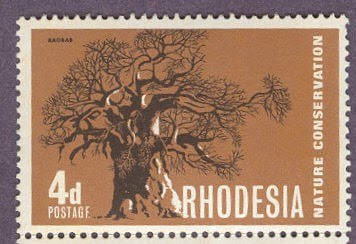
In Africa, giant baobab trees are found in Tanzania, Ethiopia, Kenya, Mozambique etc. Total 33 countries (Africa has 54 countries) of western and central African countries, have the baobab trees. Besides the continents of Africa and Australia, it is found across Barbados, Hawaii, Sri Lanka, including India. The baobab is a feature in postage stamps of the countries where they are found in abundance. 

A beautiful emission by French Post (Source: Internet)

The tree has several names. Because of its branch sprouting from the top, it is called ‘Upside down tree’ or the tree that fell from the heavens. The seeds have high content of vitamin C, which has earned the Lemonade tree name. In Tanzania, Africa in Swahili language, its name is Ubuyu.  Ubuyu, the baobab fruits are especially enjoyed by the local children. The ubuyu experience is enjoyed while sucking the dyed red baobab seeds that have been boiled and coated in a lavish mix of sugar, salt, black pepper, cardamom, and vanilla. 

An endemic to Tanzania (Location: Bagamoyo, Tanzania)

Believe me, baobab trees, though not native of India, are found in many places in the country. They are still growing in places of Bihar, Jharkhand, Goa, Gujarat (Kutch, Kathiawar etc.), Madhya Pradesh, Andhra Pradesh, Tamil Nādu etc. Now, a pertinent question is how these botanical giants have arrived in India?

Another botanical giant at Bagamoyo, Tanzania

The first theory is that the seeds or pods of baobab might have floated and drifted from African coastline to Indian shore. The second one makes sense that these plants have arrived in India, courtesy sailors, tradesmen, militia etc., of bygone era. The pods of baobab are rich in vitamins and proteins. They are lightweight and convenient to carry for long journey and fit for prolonged storage. Thus, we may conclude that the pods of baobab have been brought to India by human travellers from outside. There is a third angle as well. Millions of years ago, the collision in Gondwanaland has created today's Australia, India and Madagascar. They have certain similar geographical characteristics. Could that be a reason too?


Baobab from Barbados Post (Source: Internet)

In India, baobab is known by different names in different regions. In Hindu mythology, it has been referred as Kalpavriksh, Kalptaru, Parijaat, Manokamna purti, Ikchha purti or a Wish fulfilling tree. 

From India Post

A se-tenant pair of two stamps on Parijat tree was issued by India Post on 08 March 1997. One stamp depicts the the wide trunk of the Baobab tree and other other stamp has an image of its flowers. 

In Sanskrit, it was referred as Chitrala. A lone, a wish bearing baobab tree stands with religious punctuation in the village called Kintoor, near Barabanki, Uttar Pradesh, India. 

Baobab aka Kalpbriksh at Kintur (Courtesy: https://doi.org/10.1371/journal.pone.0227352.g004)


A Carbon-14 dating conducted in 2019, has given the calibrated age as 775+/- 25 calendar years. According to local folklore, the said tree is known as Parijaat which has grown from the ashes of Kunti, mother of Pandavas of epic Mahabharat, in that place. There are other legends about the tree with different celestial connections. Local people gather to worship the tree, newlyweds’ prey for blessing and a village fair is held every Tuesday near the tree.

In India, another old Baobab tree survives inside Naya Qila (New Fort) near Golkonda Fort, Hyderabad. The diameter of the trunk, at the base, is approximately 25 meter. 
"There's a concealed room in this trunk with space 25-30 people. ...during an attack on the fort, around 20 members of the royal family hid in this room. The entrance, located at the top, allowed entry into a adrk room where a platform-like structure made of stone hinted at makeshift cooking during those days." (Source: Times of India, 31 March 2024).

Her Excellency and baobab (Bechuanaland Protectorate is today's Botswana): Source: Internet

His Excellency with Baobab and Buffalo (Source: Internet)


Emission by Botswana Post (Source: Internet)

There are other Indian names for baobab tree in India. Because of its sour taste (high vitamin C content), it has been related to imli or tamarind in Indian languages. In Hindi, it is called Gorak-amli. It is Aane hunase in Kannada, Aanipuliya maram in Tamil, Brahma malika in Telegu.

Baobab and Botswana Post (Source: Internet)

In central India, Mandu or Mandavgarh (Dhar district) is an ancient city, located in Malwa and Nimar region of western Madhya Pradesh. According to horticulture department of the state, it has more than 1000 baobab trees in the state. Possibly the largest cluster of baobabs in India is available there. It's fruits are called Mandu ki Imli (tamrind of Mandu) or Khorasani imli. It was brought to the region during the reign of Mahmud Khilji in the 14th century. Thus, the name has been attached to Khorasan (region covering present day Iran, Turkmenistan and Afghanistan). 
Indore is another city of Madhya Pradesh. In the compound of Indian Institute of Management, Indore there are three baobab trees.


Beautiful design (Source: Internet)

A bizarre case of taking away of a dozen of baobab trees from the local tribals (Bhils) came to light in June 2022 from Dhar district of Madhya Pradesh, India. There was big protest from residents when they found and stopped trucks loaded with baobab trees to be transported from their locality to a proposed commercial botanical garden at outskirts of Hyderabad, nearly 1000 kilometre away. The protesting villagers were subsequently pacified by the intervening civil administration and baobab trees commenced their journey from central India to southern India! In 2023, the state has applied for its Geographical Index (GI) tag.

In Orchha, Madhya Pradesh there is an enormously large baobab tree which was planted by Maharaja Bir Singh Deo (1605-1626/7), the Bundela Rajput king of Orchha. The great ruler was credited of building forts of Datia, Jhansi and temples at Mathura, Varanasi etc.

Baobab provides food and shelter to wildlife (source: Internet)

From central India, let us have a look at eastern India. A very old Baobab tree is standing tall in the campus of Langat Singh College, Muzaffarpur, Bihar. There are a few baobab trees near Doranda College, Ranchi, Jharkhand. However, sometime back two of them were cut down when there was requirement of widening the road. 

Baobab and message of conservation (Source: Internet)

In the western part of India, Udvada, Pardi taluka, Valsad district, Gujarat is a coastal town. There exists a Baobab tree near the coast. There are eight Baobab trees near Vadodara, Gujarat. In Mumbai, Maharashtra there is one big baobab tree in the heart of the city, near the entrance of Rani Bagh. A few more baobab trees are there within SEEPZ area, Andheri locality of Mumbai. In the premises of Governor's house  in Mumbai there is another big baobab tree.
A very large baobab tree exists at Nagoa beach of Diu Island. 

Southern Rhodesia is present day Zimbabwe (Source: Internet)

In southern part of India, there are places where baobabs are sighted. In Chennai, there is a very large baobab tree at the Theosophical Society in Adyar. The society was established by Madame Blavatsky, the Russian psychic. 

Northern Rhodesia got independence in 1966, became Zambia (Source: Internet)

In Hyderabad, Telangana State, near Golconda fort there is a giant baobab tree which is known as Hathion ka ped (the Elephantine tree). About 10 to 15 trees existing in Hyderabad, near Quthbullapur Municipal office (HMT) Balanagar, and Narsing, Tolichowki area. One can find five baobabs in Pondicherry town.

Southern Rhodesia became Zimbabwe in 1980 (Source: Internet)

As baobabs grow, with the progress of their age, they hollow out inside. Its hollow trunk provides resting space to the travellers. Some of the trunks have served as stables for animals, burial sites and even as prison! And a bar!! 

Baobab dominated stamps of Zimbabwe, pre and post independence (Source: Internet)

In the hollowed trunk of a very old baobab tree, there was a bar. The particular gigantic baobab tree was located in South Africa. In 2009, the department of chemistry, Babes-Bolyai University, Romania estimated the age of that baobab to be 6000 years. The height of the baobab was about 75 feet and the circumference was of more than 108 feet. By some natural process, the trunk of the tree was split into two divisions yet remained conjoint through a passage. Over a period of time, its trunk hollowed within. Since 1933, people started using the hollowed space inside as a small pub. At a later date, the Heather and Doug Van Heerden of Sunland Farm took lease and created a formal bar within its hollow core space. 

Pub inside of the then Pub Tree (Courtesy: amusingplanet.com)

In the tourist circuit, it earned fame as Sunland Baobab Tree, or precisely Pub Tree, a must-see destination in Limpopo province of South Africa. It had a seating capacity of fifteen persons. The inside ceiling of the bar was at 13 feet. Draft beer, accompanied by music was served to the guests. Out of two parts of the trunk, one trunk collapsed in 2016. In March 2019, the Van Heerdens announced the shutting down of popular tourist baobab bar forever. 

Baobab seed oil is a natural skincare and haircare, moisturiser and insect repellent!

But baobab is also a type of crude petroleum oil. Baobab crude oil has a worldwide market due to its ability to remain in liquid state, without freezing, even at (-) 40 degree celsius! Baobab oil field is an ultra-deep-water basin, located at about 25 km off the coast of Cote d' Ivorie (formerly Ivory Coast) at a water depth of 900-1,500 meter. The oil field was discovered in March 2001 and Canadian Natural Resources (CNR) started development work in 2003. The commercial production commenced in August 2005. It produces both crude petroleum oil and natural gas.

Baobab trees are living witnesses of evolving civilisation, have seen rise and fall of several dynasties, etc., yet remained mute spectators. Wish they could speak and throw some light about our lives on earth, several centuries ago.

*****************
The story was published in popular philatelic e-magazine 'Ananthapuri Stamp Bulletin' August 2023 issue. Scans of select pages are as under:

The cover page


The Index

Page 1 of 3

 
Page 2 of 3

Page 3 of 3

Webliography:
1.https://www.britannica.com/plant/baobab-tree-genus
2.https://en.wikipedia.org/wiki/Parijaat_tree,_Kintoor
3.https://www.peepultree.world/livehistoryindia/story/snapshort-histories/baobab-tree
4.https://theindianvegan.blogspot.com/2013/03/all-about-baobab-in-india.html
5.https://outreachecology.com/landmark/lti_d050/
6.https://inhabitat.com/grab-a-drink-inside-a-6000-year-old-baobab-tree-at-south-africas-sunland-bar/big-baobab-bar-south-african-toursim7/
7.https://www.usatoday.com/story/news/factcheck/2021/03/23/fact-check-pub-inside-south-african-baobab-tree-now-closed/4802156001/
8.https://www.amusingplanet.com/2011/11/sunland-baobab-bar-inside-hollowed-out.html
9.https://pdfs.semanticscholar.org/8a1e/b8cb359287f50ae887cfec61f310e8375c70.pdf

Disclaimer:

The noble objective of this blog, is to promote the hobby of philately through images of stamps, a few pictures and related narration. Some of the scans and pictures featured in this blogpost are mine while others (sourced from internet) are the properties of their respective owners. No intention to infringe any type of copyright. 

The information provided in the article is for general informational purposes only. All information is provided in good faith. This is only for sharing of knowledge of philately with philatelist fraternity of the world. No commercial or political angle, whatsoever, is involved. Under no circumstances, I shall have any liability for reliance on any information provided in the story.


Narain Niwas Palace Hotel – A Heritage Hotel at Jaipur, Rajasthan, India

  Narain Niwas Palace Hotel Imagine about India before 1947, a mosaic of glittering princely states ruled by majestic kings, queens, rajas, ...